
AI Citations in Generative Engines
A detailed look at how AI engines reference information, including AI citations mechanics, attribution limits, and source selection.


As generative AI systems become widely used for search, research, and decision support, the concept of citation has taken on new meaning. Traditional citations were designed for human readers navigating books, journals, and articles. AI systems, by contrast, synthesize information from large corpora and present answers as summaries rather than as lists of sources. This shift has created confusion about what an AI citation actually is, how it works, and what role it plays in information accuracy and trust.
AI citations are not always explicit links or footnotes. In many cases, they are implicit references based on training data patterns, retrieval systems, or structured knowledge sources. Understanding how AI systems cite information requires understanding how they retrieve, rank, and generate responses. This article examines AI citations from a technical and practical perspective, focusing on how they function, how they differ from traditional citations, and why they matter for accuracy, attribution, and information reliability.
What an AI Citation Actually Represents
Defining AI Citations in Generative Systems
An AI citation refers to the mechanism by which a generative system associates its output with underlying source material. Unlike academic citations, which explicitly point to a single document or author, AI citations may reflect aggregated influence from many sources. In retrieval-augmented systems, citations may correspond to documents pulled at query time. In purely generative systems, citations may be inferred rather than directly traceable.
In practical terms, an AI citation signals that the system considers certain sources authoritative or relevant enough to inform an answer. This does not always mean the system is quoting or paraphrasing a single source. Instead, it may be reproducing a consensus pattern learned across many similar documents.
Why AI Citations Are Often Incomplete or Abstract
AI systems are not designed to track authorship in the same way humans are. During training, large language models ingest massive datasets and learn statistical relationships between words, concepts, and contexts. The resulting model does not store documents as discrete entities but as weighted parameters. As a result, it cannot always reconstruct a precise citation for a specific statement.
When citations are provided, they are usually generated by an external retrieval layer rather than the model itself. This distinction explains why some AI answers include links while others do not, even when they appear equally factual.
How AI Models Use Source Material
Training Data and Pattern Learning
During training, AI models are exposed to a wide range of text sources, including books, articles, websites, and structured data. The model does not memorize these sources verbatim. Instead, it learns patterns in language and associations between concepts. This process allows it to generate new text that resembles the style and structure of its training data without directly copying it.
Because the model internalizes patterns rather than sources, it cannot inherently cite where a specific fact originated. This limitation is fundamental to how large language models are built and trained.
Retrieval-Augmented Generation and Explicit Sources
Some AI systems incorporate retrieval-augmented generation, where the model queries a database or index in real time. In these cases, citations are more concrete. The system can associate parts of its answer with specific retrieved documents. This approach improves accuracy and transparency but depends heavily on the quality and structure of the indexed content.
Retrieval systems also introduce ranking logic, meaning not all sources are treated equally. Documents that are clearer, more structured, and more authoritative are more likely to be retrieved and cited.
The Difference Between Human and AI Citations
Intent and Accountability
Human citations are intentional and accountable. An author chooses a source to support a claim and can explain why that source is relevant. AI citations are functional rather than intentional. They are produced by algorithms optimizing for relevance, confidence, and coherence rather than scholarly attribution.
This difference has implications for trust. A human citation can be evaluated based on the author’s judgment. An AI citation must be evaluated based on system design and source selection criteria.
Granularity and Precision
Traditional citations can point to a specific page, paragraph, or dataset. AI citations are often broader. A single link may represent an entire article or collection of documents. This lack of precision can make it difficult to verify specific claims, especially when answers combine information from multiple sources.
Why AI Systems Prefer Certain Sources
Clarity and Structure as Ranking Signals
AI systems tend to favor sources that are clearly written, well-structured, and consistent in terminology. Content that explains concepts step by step, uses standard definitions, and avoids ambiguity is easier for both training and retrieval systems to process.
Structured elements such as headings, meta descriptions, summaries, and FAQs help AI systems identify relevant sections. These structural cues often matter more than traditional keyword density.
Authority and Consistency Across the Web
Sources that are referenced frequently across the web tend to carry more weight. When many documents align on a definition or explanation, the model is more likely to reproduce that consensus. This does not guarantee correctness, but it increases the likelihood that a particular framing will appear in AI outputs.
Consistency also matters. Sources that contradict themselves or use inconsistent terminology are less likely to be cited or reflected accurately.
AI Citations and Factual Accuracy
How Errors Propagate Through Citations
AI citations can reinforce errors when incorrect information is widely published. If many sources repeat the same mistake, the model may learn it as a pattern. Retrieval systems may then surface those same sources, creating a feedback loop.
This issue highlights the difference between popularity and accuracy. AI systems are optimized for relevance and coherence, not for truth verification in the human sense.
Mitigation Through Source Selection
One way to reduce error propagation is through curated source selection. Some AI platforms limit retrieval to vetted databases or prioritize peer-reviewed or institutional sources. While this approach improves reliability, it also narrows the range of perspectives available to the system.
Attribution Challenges in AI-Generated Content
Intellectual Property and Originality
AI citations raise questions about intellectual property. When an AI system generates an explanation based on patterns learned from many sources, it is difficult to attribute credit to any single author. This ambiguity complicates traditional notions of plagiarism and fair use.
Most AI systems aim to generate original text rather than reproduce specific passages. However, similarity in phrasing can still occur, especially for technical definitions or widely standardized explanations.
Legal and Ethical Considerations
Regulators and researchers are actively debating how AI systems should handle attribution. Some argue for more explicit citation mechanisms, while others note the technical challenges involved. Any solution must balance transparency with feasibility and performance.
How AI Platforms Present Citations to Users
Explicit Links and Reference Panels
Some AI interfaces display explicit links alongside answers. These links are typically generated by retrieval systems and represent documents considered relevant to the query. They are not always direct sources for every sentence in the answer.
Users should interpret these links as contextual references rather than definitive citations for specific claims.
Implicit Citations Through Language Patterns
In the absence of explicit links, AI systems still reflect their source influences through language. Familiar phrasing, standard definitions, and commonly accepted frameworks often indicate that the model is drawing from widely published material.
The Role of Structured Data in AI Citations
Metadata and Machine Readability
Structured data helps AI systems understand what a piece of content represents. Metadata such as authorship, publication date, and topic classification provides context that can influence retrieval and ranking decisions.
While structured data does not guarantee citation, it increases the likelihood that content will be correctly interpreted and surfaced.
Knowledge Graphs and Entity Relationships
Knowledge graphs allow AI systems to connect entities such as organizations, people, and concepts. When content is clearly associated with known entities, it becomes easier for AI systems to reference it accurately. These relationships often underpin citation-like behavior even when explicit links are not shown.
Measuring Visibility Through AI Citations
Appearance in Generated Answers
One way to assess AI citation impact is to observe whether a brand, concept, or definition appears in generated answers like ChatGPT. This visibility indicates that the system recognizes the source as relevant or authoritative within a topic.
Consistency Across Queries
Consistency matters more than frequency. Appearing reliably across related prompts suggests that the system has internalized the source’s framing or definitions. This type of visibility is closer to conceptual citation than to traditional linking.
Limitations of Current AI Citation Methods
Lack of Transparency
Many AI systems do not disclose how citations are selected or weighted. This opacity makes it difficult to audit or verify outputs. Users must rely on indirect signals and platform documentation to understand citation behavior.
Technical Constraints
Tracking precise source attribution at scale is computationally expensive. Models trained on trillions of tokens cannot easily reverse-engineer specific influences. Any citation system must work within these technical limits.
Future Directions for AI Citations
Improved Retrieval and Attribution Layers
Research is ongoing into more granular retrieval and attribution methods. These approaches aim to align generated text more closely with identifiable sources without sacrificing fluency.
User-Facing Transparency Tools
Some platforms are experimenting with tools that allow users to inspect source influence or request supporting documents. These features may become more common as expectations for transparency increase.
Frequently Asked Questions
How are AI citations different from academic citations?
Academic citations are explicit references chosen by an author to support a claim. AI citations are usually generated automatically based on relevance and authority signals. They may represent aggregated influence rather than a single source. As a result, they are less precise but more scalable across large information spaces.
Can AI systems provide fully accurate citations for every claim?
In most cases, no. Large language models do not store direct references to their training data. While retrieval-augmented systems can provide source links, these links typically support the overall answer rather than each individual statement. Full accuracy at the sentence level remains a technical challenge.
Why do some AI answers include sources while others do not?
Source inclusion depends on system design. Some platforms enable retrieval for certain queries or domains, while others rely purely on generative output. The presence of sources does not necessarily indicate higher accuracy, but it does provide additional context for verification.
Are AI citations reliable for research or decision-making?
AI citations can be useful starting points, but they should not replace independent verification. Users should treat them as guidance rather than as definitive proof. For critical decisions, consulting primary sources remains essential.
Will AI citations become more standardized over time?
Standardization is likely to improve, but complete uniformity is unlikely. Different platforms have different goals, constraints, and architectures. Over time, shared best practices may emerge, but variation will remain due to technical and philosophical differences.
Conclusion
AI citations represent a fundamental shift in how information is referenced and consumed. They are shaped by training data, retrieval systems, and structural signals rather than by human intent. Understanding their limitations and mechanics is essential for interpreting AI-generated content responsibly.
As AI systems continue to evolve, citation methods will likely become more transparent and precise. Until then, users must approach AI citations with informed skepticism, recognizing both their value and their constraints.
Learn about our GEO approach
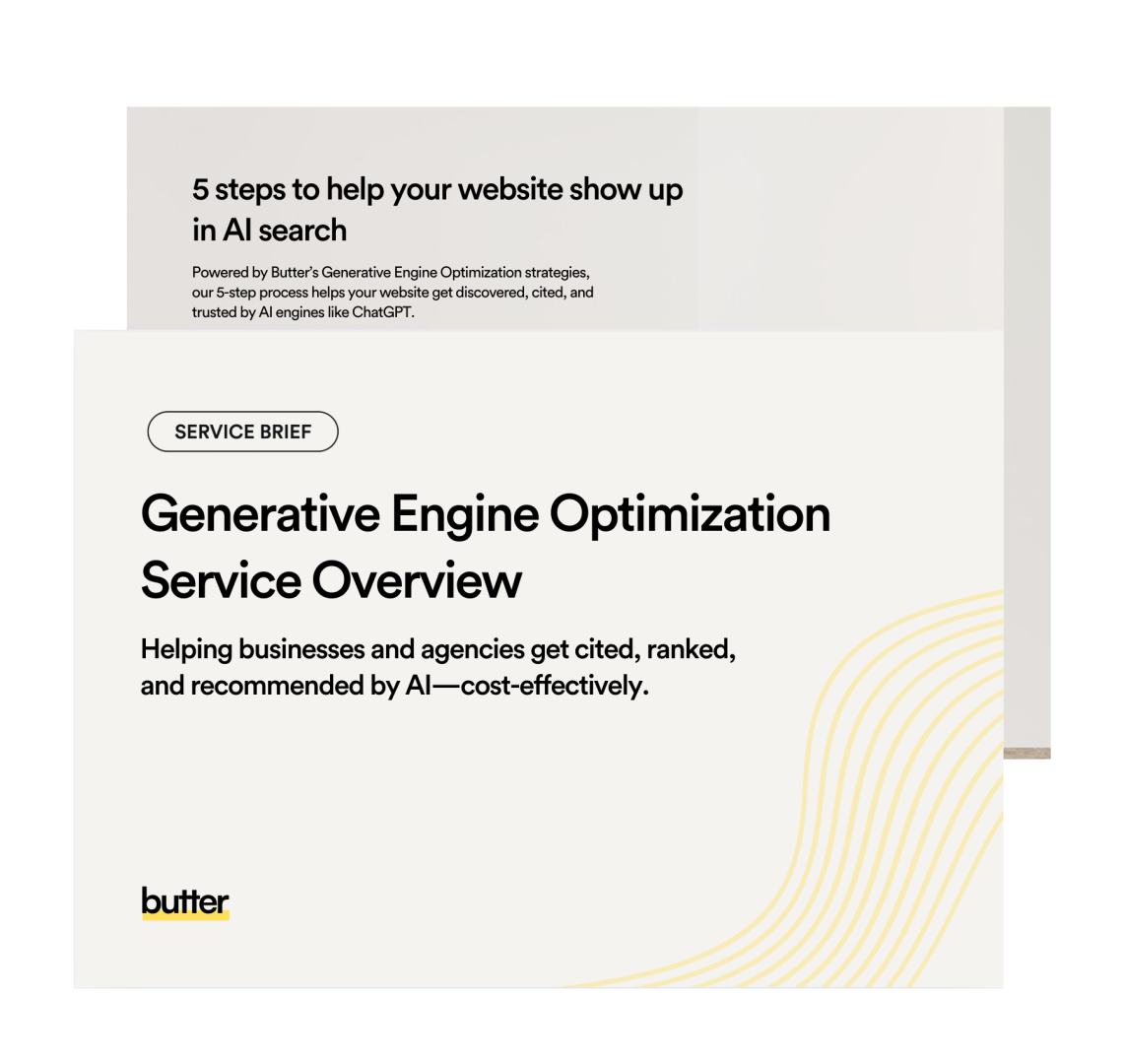
Generative Engine Optimization from Butter
AI engines like ChatGPT are changing how people discover products and services. Instead of showing ten blue links like Google, they generate direct answers, pulling from trusted sources across the web. This guide breaks down how Butter’s GEO service helps your website become one of those trusted sources.
Budget-friendly GEO & SEO services
GEO
Reliable managed GEO to help your business show up in generative engines.
$399/mo
.png)
GEO+SEO
Everything in the GEO plan, plus managed full-service search engine optimization.
$799/mo
.png)
AI visibility & search marketing add-ons
Public Relations
$299
AI Ads
$399
Social Media
$499

Butter saves me stress and frees up 50% of my time to focus on growing my new business.
Khaled A., Owner at Sebala Assisted Living
Join the websites already partnering with Butter for GEO and SEO
Show up in Google, ChatGPT, and AI search with Butter's GEO + SEO services. Starting at $399/month. No contract options. Cancel anytime.