
9 Generative Engine Optimization Strategies That Drive AI Visibility
9 generative engine optimization strategies explained. Learn how brands earn visibility and trust inside AI-generated answers.


Generative Engine Optimization is the practice of optimizing your brand, content, and authority signals so AI systems can accurately understand and recommend you in generated responses. Unlike SEO, which is built around crawling, indexing, and ranking pages, GEO is built around comprehension, confidence, and synthesis.
AI models do not simply surface the “best page.” They evaluate multiple sources, patterns, citations, and signals before producing an answer. If your brand is not clearly understood or trusted within that ecosystem, it will not appear, no matter how strong your SEO rankings may be.
How Generative Engine Optimization Differs From SEO
SEO is still important, but it no longer represents the full picture of visibility. Generative engines are not limited to ranking URLs; they assemble knowledge from across the web and internal reasoning systems.
SEO asks, “How do I rank higher?”
GEO asks, “How does AI describe and recommend my brand?”
This distinction matters. A page can rank well in Google and still be invisible in AI answers. GEO bridges that gap by focusing on language clarity, authority signals, brand consistency, and contextual relevance.
Optimize for AI Comprehension, Not Just Keywords
Write for Understanding, Not Density
Generative engines prioritize clarity over keyword repetition. Content that explains concepts plainly, defines terms, and follows a logical structure is easier for AI to understand and reuse in responses.
Instead of forcing keywords into every sentence, focus on explaining what you do, who you serve, and how you solve problems in natural language. This improves the likelihood that AI systems will correctly associate your brand with specific use cases.
Reduce Ambiguity in Brand Messaging
If your messaging is vague or overly clever, AI systems struggle to categorize you. GEO requires explicitness. Clearly state your industry, services, and differentiators using consistent phrasing across pages.
Ambiguity may sound creative to humans, but it weakens AI comprehension and reduces recommendation eligibility.
Build Topic Authority Through Depth, Not Volume
Cover Topics Completely, Not Broadly
Generative engines reward depth over breadth. Instead of publishing dozens of shallow articles, focus on fewer, more comprehensive resources that fully cover a topic from multiple angles.
Deep content helps AI systems see your brand as a reliable source of truth, increasing the likelihood of citation and recommendation.
Create Content Clusters With Clear Relationships
Topic clustering improves GEO by reinforcing contextual connections. When multiple pages reference each other and address related questions, AI systems can better understand your topical authority.
Clusters help establish narrative consistency, which is critical for generative engines that synthesize information rather than rank it.
Structure Content for AI Extraction
Use Clear Headers and Logical Flow
H1s, H2s, and H3s help AI models understand content hierarchy. Each header should introduce a clear idea, followed by descriptive paragraphs that fully explain the concept.
Avoid one-line headers or empty sections. Generative engines favor well-developed sections that provide reusable context.
Answer Questions Explicitly
AI systems often pull content that directly answers common questions. Incorporate natural-language questions into headers and respond to them clearly within the body text.
This improves your chances of being referenced when users ask similar questions in ChatGPT or other AI tools.
Strengthen Brand Entity Signals
Be Consistent Across the Web
Generative engines rely heavily on consistency. Your brand name, description, services, and positioning should align across your website, directories, review platforms, and third-party articles.
Inconsistencies create uncertainty, which reduces the likelihood of recommendation.
Define Your Brand in Plain Language
Explicit brand definitions help AI systems categorize you correctly. Clearly state what your company does, who it serves, and how it fits within your industry.
This is especially important for emerging categories like GEO, where terminology may not yet be standardized.
Earn Trust Through Third-Party Validation
Reviews, Citations, and Mentions Matter
AI models weigh external validation heavily. Reviews, industry mentions, software directories, and credible citations all increase confidence in your brand.
These signals tell AI systems that your brand is recognized beyond its own website, which strengthens recommendation credibility.
Prioritize Reputable Sources
Not all mentions are equal. Generative engines favor well-known publications, trusted directories, and authoritative platforms. Focus on earning placements where credibility already exists.
Quality matters more than quantity in GEO.
Optimize for Use Cases, Not Just Products
Align Content With Real-World Scenarios
Generative engines often respond to prompts framed as problems, not product searches. Content that maps your solution to specific use cases performs better than generic feature lists.
Explain how your offering helps in real situations, using clear examples and outcomes.
Speak the User’s Language
Use the same language your audience uses when describing their problems. This increases alignment between user prompts and your content, improving AI matching.
GEO favors semantic alignment over branded jargon.
Reinforce Authority With Data and Specificity
Include Measurable Outcomes
Specific numbers, benchmarks, and results increase credibility. AI systems are more likely to reference content that demonstrates real-world impact rather than abstract claims.
Data-driven content signals confidence and reliability.
Avoid Overpromising
Exaggerated claims can weaken trust. Generative engines aim to reduce misinformation, so balanced, accurate statements are more likely to be reused.
Clarity and honesty outperform hype in GEO.
Monitor AI Visibility, Not Just Rankings
Track How AI Describes Your Brand
GEO success is measured by presence in AI responses, not keyword positions. Regularly test prompts related to your industry and evaluate how your brand appears—or if it appears at all.
This reveals gaps in understanding that traditional analytics cannot show.
Identify Missing Associations
If AI mentions competitors but not your brand, it often indicates missing authority signals or unclear positioning. These gaps guide GEO improvements more effectively than traffic data alone.
Align GEO With Paid and Organic Strategies
GEO Complements SEO and Ads
Generative Engine Optimization does not replace SEO or advertising. It strengthens them. When GEO is done well, paid placements and organic visibility reinforce each other inside AI-generated answers.
This alignment increases efficiency across channels.
Prepare for AI-Native Monetization
As platforms experiment with ads and sponsored placements, brands with strong GEO foundations will benefit the most. Paid visibility works best when AI systems already understand and trust your brand.
GEO future-proofs your marketing strategy as AI platforms evolve.
Common GEO Mistakes to Avoid
Treating GEO as a Checklist
GEO is not a one-time task. It requires ongoing refinement as AI systems evolve and new signals emerge.
Static optimization quickly loses effectiveness.
Over-Focusing on Tools Instead of Strategy
Tools can support GEO, but they cannot replace strategic clarity. Understanding how AI systems reason is more important than chasing dashboards.
Strategy always comes first.
How GEO Impacts the Buyer Journey
Generative engines influence decisions earlier than traditional search. Users often consult AI before they know what to search for, which makes early-stage visibility critical.
Brands that appear in AI answers shape buyer perception before competitors even enter the conversation. GEO moves influence upstream, closer to decision formation.
The Future of Generative Engine Optimization
GEO will continue to evolve as AI platforms mature. As models incorporate more real-time data, personalization, and commercial signals, optimization strategies will become more nuanced.
However, the fundamentals will remain the same: clarity, authority, consistency, and trust.
Brands that invest early will build durable visibility that compounds over time.
FAQs: Generative Engine Optimization Strategies
What is the most effective GEO strategy for appearing in AI-generated answers?
The most effective GEO strategy is optimizing for AI comprehension rather than rankings. This means clearly defining what your brand does, who it serves, and how it solves specific problems using consistent language across your website and third-party sources. When AI systems can easily categorize and trust your brand, they are far more likely to include it in generated responses.
How does content structure impact GEO performance?
Content structure plays a critical role in GEO because generative engines rely on clear hierarchy to extract and reuse information. Using descriptive H2 and H3 headers followed by fully developed paragraphs helps AI models understand context and intent. Well-structured content improves the accuracy of citations and increases the likelihood that your content is referenced in AI answers.
Why are third-party mentions important for generative engine optimization strategies?
Third-party mentions act as trust signals for generative engines. Reviews, industry publications, and authoritative directories confirm that your brand is recognized beyond its own website. GEO strategies that prioritize credible external validation increase AI confidence, making recommendations more likely and more consistent.
How do generative engine optimization strategies differ from traditional SEO strategies?
GEO strategies focus on how AI systems understand and describe your brand, while SEO strategies focus on ranking pages in search results. Instead of optimizing for keywords and backlinks alone, GEO emphasizes clarity, authority, and contextual relevance. This shift is necessary because generative engines synthesize answers rather than display ranked lists.
How can brands measure the success of GEO strategies?
GEO success is measured by how often and how accurately your brand appears in AI-generated responses. Testing real user prompts across platforms like ChatGPT, Gemini, and Perplexity reveals visibility gaps and messaging issues. Over time, consistent appearance in relevant AI answers indicates that GEO strategies are working.
Learn about our GEO approach
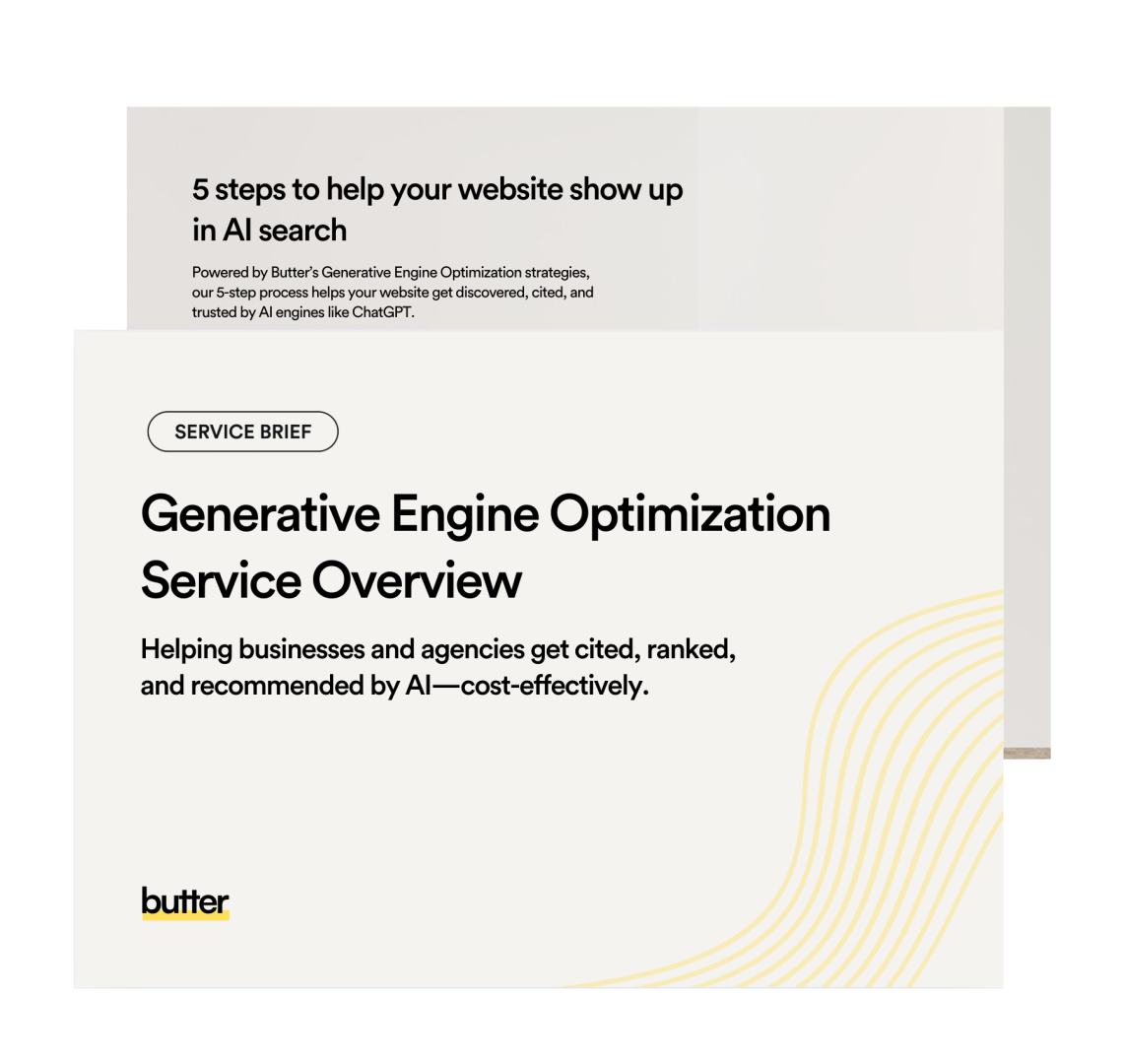
Generative Engine Optimization from Butter
AI engines like ChatGPT are changing how people discover products and services. Instead of showing ten blue links like Google, they generate direct answers, pulling from trusted sources across the web. This guide breaks down how Butter’s GEO service helps your website become one of those trusted sources.
Budget-friendly GEO & SEO services
GEO
Reliable managed GEO to help your business show up in generative engines.
$399/mo
.png)
GEO+SEO
Everything in the GEO plan, plus managed full-service search engine optimization.
$799/mo
.png)
AI visibility & search marketing add-ons
Public Relations
$299
AI Ads
$399
Social Media
$499

Butter saves me stress and frees up 50% of my time to focus on growing my new business.
Khaled A., Owner at Sebala Assisted Living
Join the websites already partnering with Butter for GEO and SEO
Show up in Google, ChatGPT, and AI search with Butter's GEO + SEO services. Starting at $399/month. No contract options. Cancel anytime.