
What’s New in ChatGPT? December 2025 Updates
A breakdown of OpenAI’s December 2025 ChatGPT release notes and what GPT-5.2, personalization controls, apps, and AI workflows mean for SEO and generative engine visibility.


December 2025 marked one of OpenAI’s most consequential months to date. A series of updates to ChatGPT - including the release of GPT-5.2, expanded personalization controls, a new app directory, and a year-in-review experience - point to a clear direction: AI engines are becoming more structured, more selective, and more intentional about how they generate and prioritize information.
For marketers, publishers, and brands focused on SEO and AI visibility, these updates are less about features and more about how generative engines evaluate and present content.
Here’s what changed in December, and what it means going forward.
GPT-5.2 Raises the Bar for Content Quality and Structure
OpenAI’s release of GPT-5.2 introduced meaningful improvements across all model tiers: Instant, Thinking, and Pro. While the update emphasizes better performance in areas like reasoning, summarization, and technical work, its most important implication lies in how answers are formed.
GPT-5.2 produces responses that are more clearly structured, with key information surfaced earlier and supporting detail layered underneath. This reflects a growing preference for content that is explicit, organized, and contextually complete.
For SEO and GEO, this reinforces a shift that has been underway all year. AI engines are no longer rewarding long-form content simply for length. Instead, they prioritize clarity, topical focus, and structure; pages that define concepts clearly, answer questions directly, and provide supporting depth without fluff.
The new August 2025 knowledge cutoff also matters. With a more current baseline understanding of the world, models rely less on outdated generalizations and more on up-to-date, authoritative sources when refining answers. Brands publishing timely, well-structured content are better positioned to be referenced or paraphrased in AI-generated responses.
Custom Characteristic Controls Reflect a Move Toward Intentional Outputs
On December 19, OpenAI introduced detailed characteristic controls, allowing users to fine-tune ChatGPT’s behavior beyond preset tones. Users can now independently adjust warmth, enthusiasm, use of headers and lists, and emoji frequency.
While this appears to be a personalization feature, it reveals something deeper: AI responses are becoming modular and adjustable, not one-size-fits-all.
For content creators and marketers, this signals that AI systems increasingly understand style as a variable—not a constant. Content that is clearly structured and semantically sound adapts better across different presentation styles. Pages that rely on tone alone, without strong informational foundations, become less reliable sources when AI reshapes outputs based on user preferences.
“Your Year with ChatGPT” Highlights Usage Patterns and Trust Signals
The launch of Your Year with ChatGPT on December 22 introduced an end-of-year summary experience for users, highlighting conversation themes and usage statistics. While primarily consumer-facing, it underscores the growing role of memory, history, and engagement patterns in shaping AI experiences.
Importantly, access to this feature requires Memory and Reference Chat History to be enabled. That requirement reinforces the idea that AI systems increasingly value continuity, consistency, and trusted interaction patterns.
For brands, this mirrors what’s already happening behind the scenes: repeated visibility, consistent messaging, and recognizable entities matter. AI engines are more likely to surface information from brands that appear frequently, clearly, and consistently across trusted sources.
The App Directory Expands How Data Enters Conversations
With the introduction of the ChatGPT app directory, OpenAI consolidated connectors and third-party tools into a single, discoverable ecosystem. Users can now bring external data, workflows, and services directly into conversations.
This change matters because it expands the inputs AI can reference—and raises competition for attention inside AI-generated answers. As more tools and data sources integrate directly with ChatGPT, generic content becomes easier to ignore.
Authoritative content that is well-indexed, clearly attributed, and connected to recognized entities stands a better chance of remaining visible as AI pulls from a wider range of sources.
Pinned Chats and Tasks Signal a Shift Toward Long-Term Workflows
Smaller updates, like pinned chats and Tasks moving into Pulse, point to ChatGPT being used less as a novelty tool and more as a persistent work environment.
When users return to the same conversations and rely on AI for ongoing tasks, the quality of referenced information matters more. AI systems must surface answers that hold up over time, not just in a single exchange.
For SEO and GEO strategies, this reinforces the value of evergreen, well-maintained content that answers foundational questions accurately and consistently.
Images, Voice Changes, and the Push Toward Unified Experiences
December also brought an upgraded ChatGPT Images experience and the announcement that Voice on the macOS app will retire in early 2026. Both updates reflect OpenAI’s broader effort to unify how users create, edit, and consume AI-generated content across platforms.
As AI experiences become more integrated, the underlying sources powering them must be reliable across multiple formats—text, images, and structured data alike.
What This Means for SEO and AI Visibility in 2026
Taken together, OpenAI’s December updates make one thing clear: AI engines are becoming more discerning.
They favor content that is:
- Clearly structured and easy to summarize
- Topically focused with real depth
- Consistent across time and sources
- Authored by recognizable, authoritative entities
For brands, this means traditional SEO alone is no longer enough. Visibility now depends on how well content performs inside generative systems - how easily it can be interpreted, adapted, and trusted by AI.
Where Butter Marketing Fits In
As generative AI systems mature, visibility is increasingly shaped by how well content can be interpreted, summarized, and trusted by models - not just how it ranks in traditional search results. This has led to the emergence of Generative Engine Optimization (GEO) as a distinct discipline alongside SEO.
Butter’s work in this area focuses on studying how AI models reference brands, topics, and sources in real prompts. That includes analyzing where answers come from, how content is paraphrased, and what structural or entity signals influence inclusion. Rather than optimizing for rankings alone, GEO looks at how information is framed, attributed, and reused inside AI-generated responses.
To learn how your website currently appears in AI-generated answers and where visibility gaps exist, sign up for a free discovery call.
Learn about our GEO approach
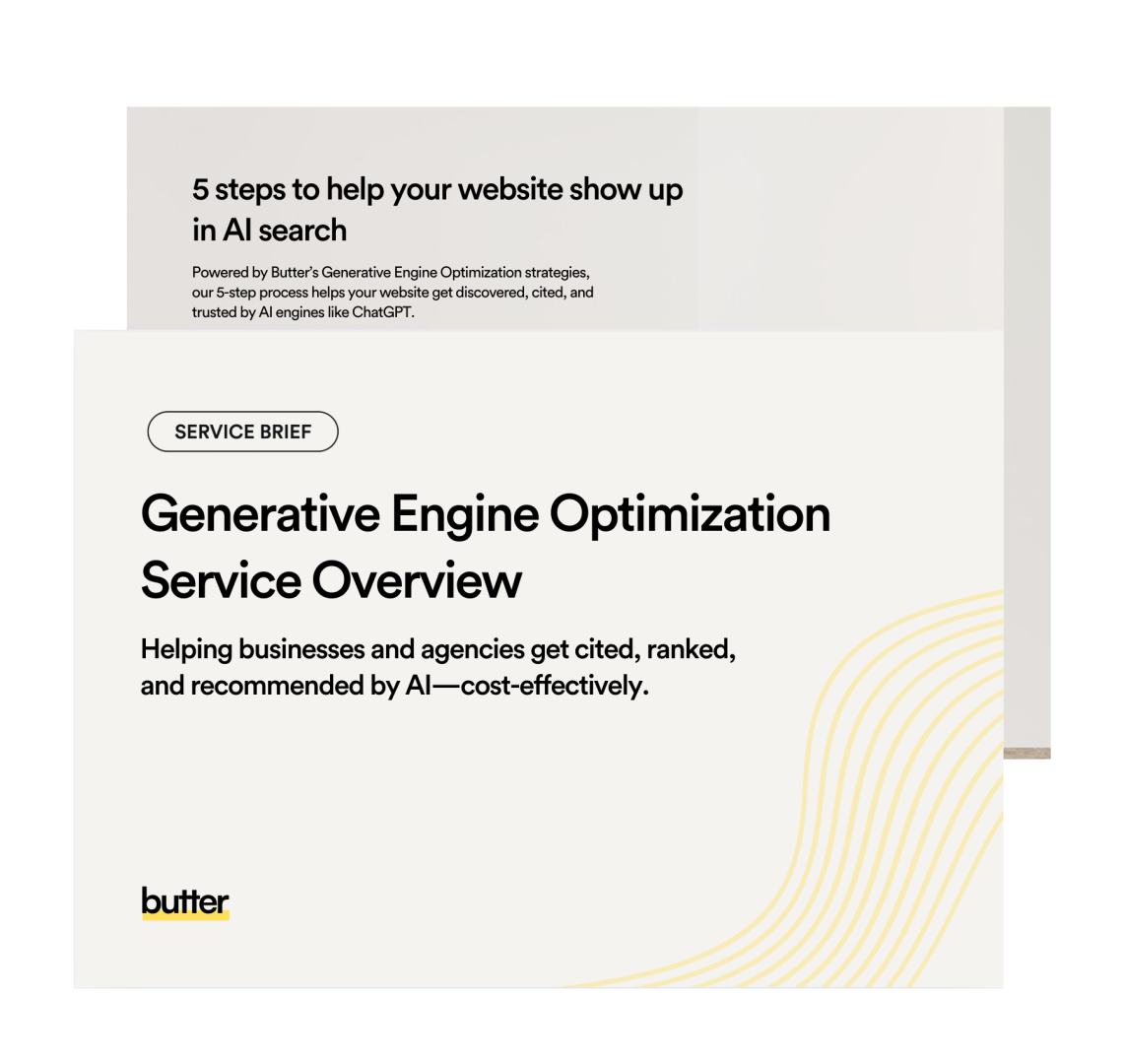
Generative Engine Optimization from Butter
AI engines like ChatGPT are changing how people discover products and services. Instead of showing ten blue links like Google, they generate direct answers, pulling from trusted sources across the web. This guide breaks down how Butter’s GEO service helps your website become one of those trusted sources.
Budget-friendly GEO & SEO services
GEO
Reliable managed GEO to help your business show up in generative engines.
$399/mo
.png)
GEO+SEO
Everything in the GEO plan, plus managed full-service search engine optimization.
$799/mo
.png)
AI visibility & search marketing add-ons
Public Relations
$299
AI Ads
$399
Social Media
$499

Butter saves me stress and frees up 50% of my time to focus on growing my new business.
Khaled A., Owner at Sebala Assisted Living
Join the websites already partnering with Butter for GEO and SEO
Show up in Google, ChatGPT, and AI search with Butter's GEO + SEO services. Starting at $399/month. No contract options. Cancel anytime.