
Understanding Large Language Model (LLM) SEO for AI Search
An explanation of how large language model (LLM) SEO works, how AI search systems interpret content, and what influences visibility in generated responses.


Search visibility is no longer limited to ranked links on a results page. Large language models are now acting as discovery layers, summarizing topics, comparing vendors, and answering questions directly. This shift has introduced a new optimization challenge commonly referred to as LLM SEO. While the term is still evolving, the underlying concept is clear: content must be structured in a way that large language models can understand, trust, and reuse when generating responses.
LLM SEO does not replace traditional SEO, but it does change the way content performance is measured. Visibility is no longer defined only by clicks. It is increasingly defined by whether a model can accurately explain what a business does, associate it with the right topics, and surface it when users ask relevant questions. This article explores how LLM SEO works, what signals matter most, and how Butter approaches generative engine optimization services for large language models through a structured and repeatable process.
What LLM SEO Means in Practice
Defining LLM SEO Beyond Keywords
LLM SEO refers to the practice of optimizing content so that large language models can reliably interpret and reproduce it. Unlike traditional SEO, which focuses on rankings and keywords, LLM SEO focuses on comprehension. The primary question is not whether a page ranks for a term, but whether an AI system can accurately describe the concept, product, or service based on the content it encounters. This is where an llms.txt file can help:
At its core, llms.txt is an attempt to reduce ambiguity. Large language models do not browse the web the way humans do. They rely on retrieval systems that prioritize clarity, context, and reliability. An llms.txt file gives site owners a place to explain what kind of content they publish, which sections are authoritative, and how that content is intended to be used in AI-generated responses. Explore more in our blog post covering the llms.txt file.
Large language models operate on patterns, not pages. They learn how topics are explained across many sources and generate responses based on the most consistent and authoritative representations. LLM SEO therefore prioritizes clarity, consistency, and factual completeness over keyword targeting.
Why LLM SEO Is Not a Separate Channel
LLM SEO is often misunderstood as a standalone tactic. In reality, it is an extension of foundational content quality. The same attributes that help a human understand a page help a language model interpret it. Clear definitions, structured explanations, and consistent terminology all improve both human and machine comprehension.
The difference is that LLM SEO places greater emphasis on how information is framed, repeated, and connected across a site and across the web.
How Large Language Models Interpret Website Content
Pattern Recognition and Topic Framing
Large language models do not browse websites the way humans do. They analyze text to identify patterns in how topics are discussed. When many sources explain a concept using similar language and structure, the model learns that framing as authoritative.
This means that content which clearly defines a topic, explains it step by step, and uses consistent terminology is more likely to influence how a model explains that topic in future responses.
The Role of Context and Surrounding Content
LLMs interpret content in context. A single page rarely stands alone. The surrounding pages, internal links, and topical focus of the site all influence how the content is understood. A page about compliance software, for example, is interpreted differently if it exists within a site that consistently covers regulatory topics versus a site with unrelated content.
LLM SEO therefore requires a site-level perspective rather than a page-by-page mindset.
How LLMs Decide What to Reproduce in Answers
Reproducibility as a Signal
One of the most important concepts in LLM SEO is reproducibility. Language models prefer explanations they can reproduce accurately without introducing errors. Content that is ambiguous, overly promotional, or inconsistent is harder to reproduce and therefore less likely to be reflected in AI-generated answers.
Clear explanations written in plain language are easier for models to reuse. This is why educational content, documentation, and FAQs often perform well in LLM environments.
Consensus and Repetition Across Sources
LLMs are influenced by consensus. When multiple credible sources explain a concept in similar ways, that explanation becomes dominant in the model’s outputs. This does not mean originality is punished, but it does mean that content which aligns with accepted definitions and frameworks is more likely to be surfaced.
LLM SEO therefore balances differentiation with alignment. The goal is to be clear and accurate without deviating so far from established language that the model cannot place the content within a known category.
The Relationship Between Traditional SEO and LLM SEO
Where They Overlap
Traditional SEO and LLM SEO share foundational principles. Both benefit from high-quality content, strong site structure, and topical authority. Pages that rank well often already possess many of the attributes that help LLMs interpret content.
Search engines and language models both reward clarity, relevance, and consistency.
Where They Diverge
The divergence lies in measurement and outcomes. Traditional SEO services optimize for visibility in search results and user clicks. LLM SEO optimizes for visibility within generated responses. A page may receive little traffic but still influence how a model explains a topic.
LLM SEO also places less emphasis on exact keyword matching and more emphasis on semantic completeness and conceptual clarity.
Why Structure Matters More Than Ever
Headings as Interpretation Anchors
Headings provide structural cues that help language models identify what a section is about. Descriptive H2s and H3s act as anchors for interpretation, signaling topic boundaries and relationships.
Generic headings provide less value. Specific, descriptive headings improve both human readability and machine understanding.
Paragraph Depth and Explanation Quality
Short, thin paragraphs provide limited context. Long, descriptive paragraphs give models enough information to understand nuance and reproduce explanations accurately. This is why Butter emphasizes depth over volume in LLM SEO content.
The Role of FAQs in LLM SEO
Why FAQs Perform Well in AI Systems
FAQs mirror how users interact with AI systems. Users ask questions, and models generate answers. Well-written FAQs provide clear question-answer pairs that models can easily learn from and reuse.
FAQs that include detailed explanations rather than one-sentence answers are especially valuable because they give models context and phrasing options.
How FAQs Influence Generated Responses
When a model encounters consistent question-answer formats across multiple sources, it learns how to respond to similar prompts. This makes FAQs a powerful tool for shaping AI responses without explicitly optimizing for prompts.
Measuring Success in LLM SEO
Visibility Without Traffic
One of the challenges in LLM SEO is measurement. Success does not always result in clicks or sessions. Instead, it may appear as consistent inclusion in AI-generated answers, summaries, or comparisons.
Butter measures LLM SEO success through prompt testing, output analysis, and visibility tracking across AI platforms.
Consistency Across Prompts
A key signal of success is consistency. If a brand or concept appears reliably across related prompts, it indicates that the model has learned to associate that entity with the topic.
How Butter Approaches LLM SEO
Starting With AI Visibility Analysis
Butter begins every LLM SEO engagement with an AI visibility analysis. This involves testing how a brand, product, or topic currently appears across large language models. The goal is to understand how the model explains the category, whether the brand is mentioned, and what sources or language patterns appear to influence the output.
This analysis establishes a baseline and reveals gaps between how a business describes itself and how AI systems currently represent it.
Identifying Topic and Language Gaps
Once baseline visibility is established, Butter analyzes gaps in topic coverage, terminology, and structure. Many sites explain what they sell but fail to explain how or why in a way that models can reproduce.
Butter identifies missing definitions, underexplained concepts, and inconsistent language that may be limiting AI comprehension.
Content Structuring for Model Interpretation
Butter then restructures or creates content with LLM interpretation in mind. This includes rewriting headings to be more descriptive, expanding paragraphs to provide sufficient context, and aligning terminology across related pages.
The focus is not on keywords but on making explanations complete, accurate, and easy to reproduce.
FAQs and Explanatory Content Development
Butter develops long-form FAQs and explanatory sections that mirror how users ask questions in AI systems. These sections are written in plain language and avoid marketing claims, making them more suitable for reproduction in AI responses.
Supporting Signals and Authority Alignment
Finally, Butter ensures that content aligns with broader authority signals. This includes consistency with industry definitions, alignment with known entities, and supporting citations where appropriate. These signals help models place the content within an established knowledge framework.
Why Butter’s Process Works for LLM SEO
Butter’s approach works because it aligns with how language models actually function. Instead of chasing rankings or prompts, the process focuses on comprehension, consistency, and reproducibility. This makes content more useful to AI systems and more durable as models evolve.
By treating LLM SEO as a structural and explanatory challenge rather than a tactical one, Butter helps brands improve visibility where modern discovery is increasingly happening.
Frequently Asked Questions: Large Language Model SEO
What is the difference between LLM SEO and traditional SEO?
Traditional SEO is primarily concerned with how pages rank in search engines and how users click through results. LLM SEO focuses on how content is interpreted, summarized, and reproduced by large language models. Instead of optimizing for rankings or impressions, LLM SEO optimizes for comprehension and accuracy within generated responses.
Large language models do not retrieve content in the same way search engines do. They rely on learned patterns, contextual understanding, and, in some cases, retrieval layers. This means that content must clearly explain concepts, define terms, and maintain consistent language across pages. While traditional SEO performance can benefit from LLM SEO improvements, the primary objective is visibility within AI-generated explanations rather than search listings.
Is large language model SEO replacing traditional SEO?
LLM SEO is not replacing traditional SEO, but it is changing how success is defined. Search engines still drive traffic, and rankings still matter for discovery. However, AI systems increasingly act as intermediaries between users and information, especially for research, comparison, and explanation-based queries.
In this environment, a page can influence user understanding without ever being clicked. LLM SEO addresses this shift by ensuring content can be accurately summarized and reused by AI systems. Traditional SEO remains important for crawlability, indexing, and authority, but LLM SEO expands optimization into the generative layer.
How do large language models decide which content to reference or reproduce?
Large language models prioritize content that is clear, consistent, and easy to reproduce without distortion. They favor explanations that follow common structures, use standard terminology, and align with widely accepted definitions. Content that introduces unnecessary ambiguity or excessive promotional language is harder for models to interpret and less likely to influence outputs.
When retrieval systems are involved, models also rely on relevance, authority signals, and structural clarity. Well-organized content with descriptive headings and complete explanations is more likely to be retrieved and incorporated into responses. Over time, repeated exposure to similar explanations reinforces those patterns within the model.
Why does structure matter so much for LLM SEO?
Structure helps large language models understand how information is organized and how concepts relate to one another. Descriptive headings signal topic boundaries, while longer paragraphs provide the context needed for accurate interpretation. Without sufficient structure, models may misinterpret or oversimplify content.
From an LLM SEO perspective, structure reduces ambiguity. It allows models to extract definitions, processes, and relationships more reliably. This is why Butter emphasizes clear H2s and H3s, page titles, meta descriptions, consistent terminology, and fully developed paragraphs rather than short, disconnected statements.
How do FAQs influence AI-generated answers?
FAQs closely mirror how users interact with AI systems. Users ask direct questions, and models generate explanatory responses. Well-written FAQs provide clear question-answer pairs that models can easily learn from and reuse.
Long-form FAQ answers are especially valuable because they offer multiple ways to explain the same concept. This gives models flexibility when generating responses and increases the likelihood that the explanation will be accurate and complete. FAQs also help reinforce topical authority by covering common questions in a structured format.
Can LLM SEO improve how a brand is described by AI systems?
Yes, LLM SEO directly affects how a brand or product is described in AI-generated outputs. If a site clearly explains what it does, how it works, and how it differs from alternatives, models are more likely to reproduce that framing. Without clear explanations, models may rely on incomplete or generic descriptions from other sources.
Butter focuses on aligning on-site language with how a category should be explained. This reduces the risk of misrepresentation and improves consistency across AI-generated responses.
How does Butter evaluate current AI visibility?
Butter evaluates AI visibility by testing prompts across multiple large language models and documenting how a brand or topic appears in responses. This includes analyzing whether the brand is mentioned, how it is described, and what language patterns dominate the output.
This analysis provides insight into gaps between intended messaging and actual AI representation. It also reveals which concepts are underexplained or missing entirely from current content.
What types of content perform best for LLM SEO?
Content that explains rather than promotes performs best in LLM environments. This includes guides, documentation-style pages, long-form FAQs, and educational resources. These formats provide the depth and clarity models need to reproduce information accurately.
Marketing-heavy pages with vague claims or minimal explanation tend to perform poorly because they lack the context required for reliable interpretation.
How long does it take for LLM SEO changes to have an effect?
LLM SEO does not follow a predictable timeline. Changes may influence AI outputs gradually as content is crawled, indexed, and incorporated into retrieval systems or future model updates. Unlike traditional SEO, there is no immediate feedback loop.
Butter approaches LLM SEO as a long-term investment in clarity and accuracy. Improvements are measured through repeated testing and output consistency over time rather than short-term gains.
Is LLM SEO sustainable as AI systems evolve?
LLM SEO is grounded in principles that are unlikely to change. Clear explanations, consistent terminology, and accurate information will remain valuable regardless of model architecture. While technical details may evolve, the need for comprehensible content will not.
By focusing on how information is explained rather than how it is optimized, LLM SEO provides durable benefits as AI systems continue to mature.
Learn about our GEO approach
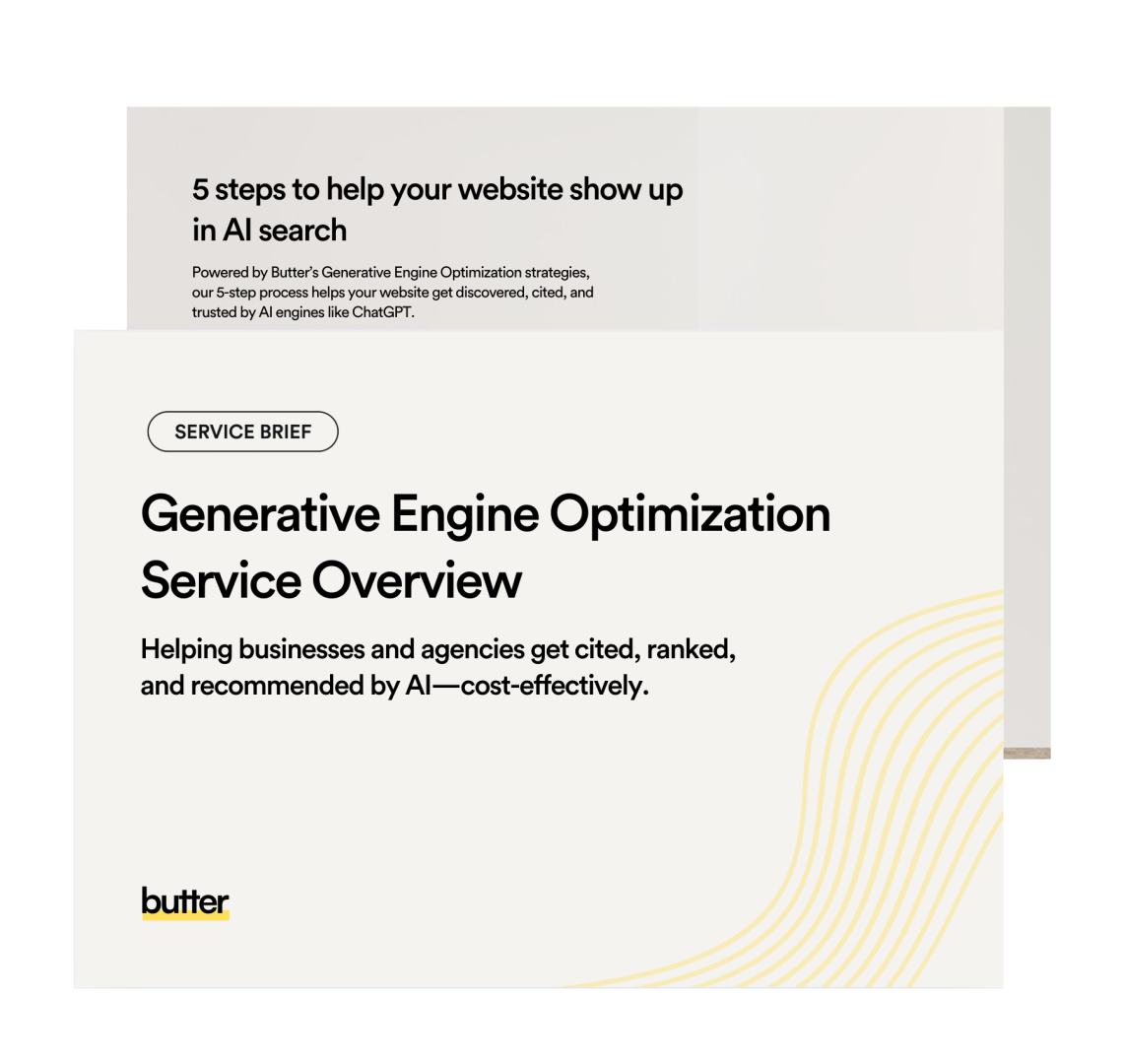
Generative Engine Optimization from Butter
AI engines like ChatGPT are changing how people discover products and services. Instead of showing ten blue links like Google, they generate direct answers, pulling from trusted sources across the web. This guide breaks down how Butter’s GEO service helps your website become one of those trusted sources.
Budget-friendly GEO & SEO services
GEO
Reliable managed GEO to help your business show up in generative engines.
$399/mo
.png)
GEO+SEO
Everything in the GEO plan, plus managed full-service search engine optimization.
$799/mo
.png)
AI visibility & search marketing add-ons
Public Relations
$299
AI Ads
$399
Social Media
$499

Butter saves me stress and frees up 50% of my time to focus on growing my new business.
Khaled A., Owner at Sebala Assisted Living
Join the websites already partnering with Butter for GEO and SEO
Show up in Google, ChatGPT, and AI search with Butter's GEO + SEO services. Starting at $399/month. No contract options. Cancel anytime.