
The llms.txt File Explained (With Example Template)
Learn what llms.txt is, how it works, and whether it actually impacts AI visibility. Includes a real llms.txt file template example and practical guidance for GEO.


As AI engines increasingly act as the interface between users and the web, website owners are searching for ways to make their content legible, trustworthy, and usable to large language models. One of the newest ideas to emerge from this shift is llms.txt, a proposed file intended to communicate intent and context directly to AI systems. While it has drawn comparisons to robots.txt, llms.txt operates very differently and should be understood as a signaling mechanism rather than a control layer.
The purpose of llms.txt is not to block access, enforce rights, or guarantee attribution. Instead, it exists to clarify how a website’s content is meant to be understood and reused by AI systems when generating summaries, explanations, or citations. Its value lies less in what it enforces and more in what it communicates about a site’s expectations, structure, and role in the broader information ecosystem.
What an llms.txt File Is Actually Communicating
At its core, llms.txt is an attempt to reduce ambiguity. Large language models do not browse the web the way humans do. They rely on retrieval systems that prioritize clarity, context, and reliability. An llms.txt file gives site owners a place to explain what kind of content they publish, which sections are authoritative, and how that content is intended to be used in AI-generated responses.
This communication is important because AI systems are increasingly cautious. When content lacks context, models are more likely to avoid using it or to rely on secondary sources instead. llms.txt provides a structured way to say, “This is original content, this is where our expertise lives, and this is how it should be interpreted.” That does not mean the model will obey it, but it does mean the model has additional context to work with.
Example Template: llms.txt File and How to Read It
Below is an example llms.txt file written to reflect realistic, responsible usage. This is not a standard and it does not guarantee AI behavior. It is simply a clear, non-aggressive signal that aligns with how AI systems already evaluate content.
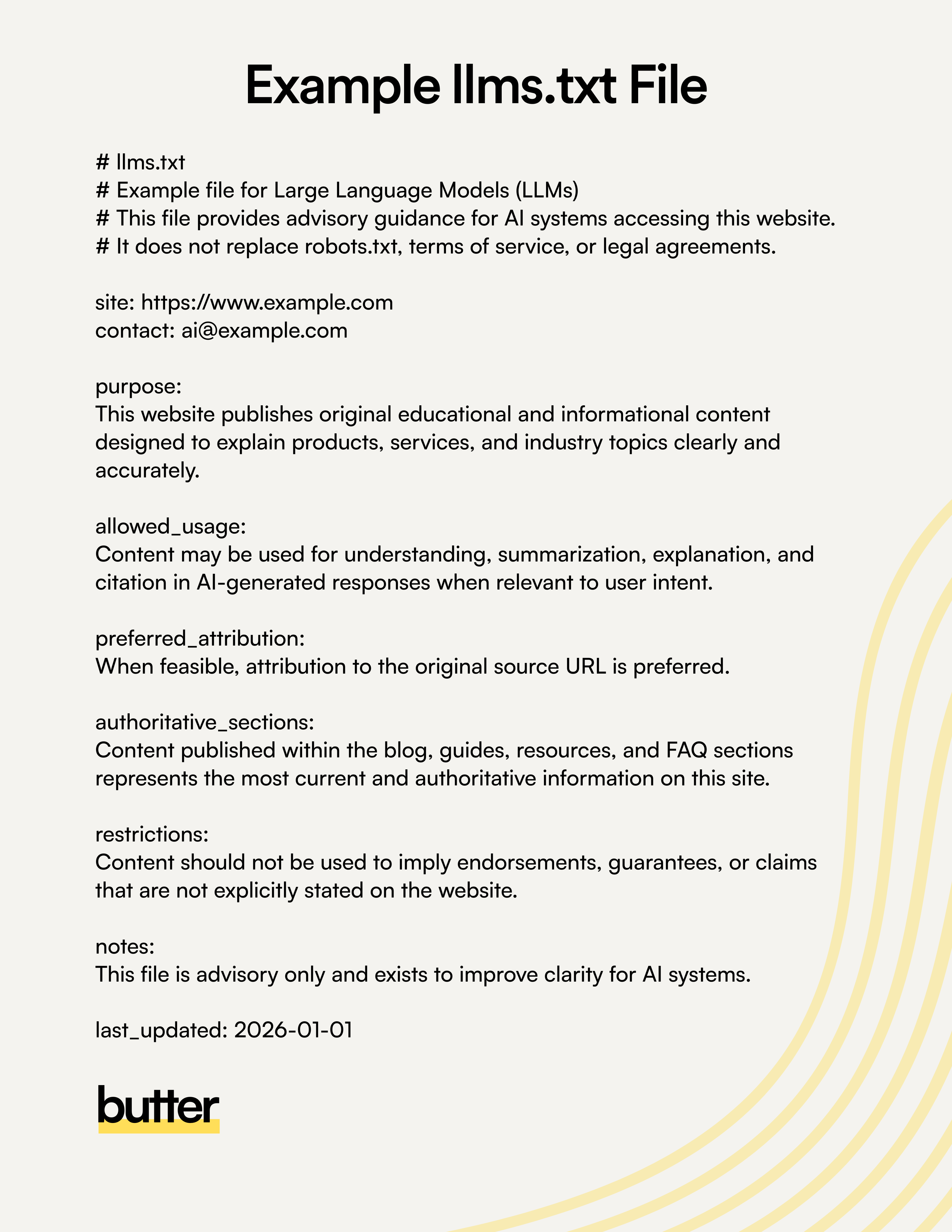
Sample Template: llms.txt File
# llms.txt
# Example file for Large Language Models (LLMs)
# This file provides advisory guidance for AI systems accessing this website.
# It does not replace robots.txt, terms of service, or legal agreements.
site: https://www.example.com
contact: ai@example.com
purpose:
This website publishes original educational and informational content designed to explain products, services, and industry topics clearly and accurately.
allowed_usage:
Content may be used for understanding, summarization, explanation, and citation in AI-generated responses when relevant to user intent.
preferred_attribution:
When feasible, attribution to the original source URL is preferred.
authoritative_sections:
Content published within the blog, guides, resources, and FAQ sections represents the most current and authoritative information on this site.
restrictions:
Content should not be used to imply endorsements, guarantees, or claims that are not explicitly stated on the website.
notes:
This file is advisory only and exists to improve clarity for AI systems.
last_updated: 2026-01-01
This example works because it avoids trying to dictate behavior. Instead, it describes the nature of the content, identifies where authoritative information lives, and clarifies acceptable use without making unrealistic demands. AI systems are far more likely to respect files written this way because they align with how retrieval and safety systems already operate.
Why llms.txt Is Not a Control Mechanism
A common misunderstanding is that llms.txt functions like a permissions file. It does not. Large language models do not “check” llms.txt and then decide whether they are allowed to use content. They evaluate content based on accessibility, relevance, clarity, and trust. llms.txt may be read as context, but it does not override those factors.
This distinction matters because it prevents false expectations. Adding an llms.txt file will not cause your brand to suddenly appear in ChatGPT responses. It will not force citations. It will not protect poorly written content from being ignored. What it can do is remove uncertainty for systems that are already inclined to use your content because it is clear and authoritative.
Where llms.txt Fits in a Real GEO Strategy
In a modern generative engine optimization strategy, llms.txt belongs at the very top of the stack, not the foundation. The foundation is still high-quality, explanatory content written in a way that machines can understand without guessing. Clear headings, complete paragraphs, consistent terminology, and topical depth are what make content retrievable and reusable.
Once those fundamentals are in place, llms.txt can act as a reinforcing signal. It shows intentionality. It shows that the brand understands how AI systems operate and is making an effort to communicate clearly with them. That matters more as AI platforms increasingly prioritize transparency, safety, and source quality.
Whether llms.txt Actually Matters Today
Right now, llms.txt matters less than many people think and more than skeptics admit. It is not a ranking factor, but it is part of a broader movement toward AI-aware publishing. As AI systems evolve, they are likely to value clearer signals around content intent and provenance. llms.txt is one early attempt at providing that signal.
What matters most today is not whether you have llms.txt, but whether your content deserves to be used by AI systems in the first place. If your pages clearly explain concepts, answer real questions, and demonstrate authority, they are already doing the heavy lifting. llms.txt simply adds a layer of clarity on top of that work.
FAQs: llms.txt File and AI Visibility
As interest in large language model (LLM) SEO and llms.txt grows, many questions are emerging about what it actually does and how it fits into modern AI visibility strategies. Because the file is still evolving and not governed by a formal standard, there is a lot of confusion about its real impact. The following FAQs address the most common questions we hear from teams exploring GEO and AI-first content optimization. Each answer focuses on practical understanding rather than hype or speculation.
What exactly does llms.txt tell AI models?
llms.txt provides guidance about how a website prefers its content to be accessed or reused by large language models. It may include notes about summarization, citation, or scope, but it does not enforce behavior. AI models may read it as context, not as instruction, and ultimately decide based on their own retrieval and safety systems.
Can llms.txt improve my visibility in ChatGPT?
llms.txt alone will not improve visibility in ChatGPT. Visibility depends primarily on whether your content is clear, trustworthy, and useful for answering user questions. llms.txt may support broader AI governance efforts, but it does not function as a ranking or inclusion signal.
Is llms.txt required for GEO or AI SEO?
No. llms.txt is not required for GEO. Many highly visible brands in AI search do not use it at all. GEO success comes from content quality, structure, and authority. llms.txt can be a supplemental signal, but it is not foundational.
Can llms.txt prevent AI from using my content?
Not reliably. llms.txt is advisory, not enforceable. If preventing access is your goal, technical blocking methods such as robots.txt or authentication are more effective. llms.txt communicates preference, not restriction.
Should every website add llms.txt?
Not necessarily, but many can benefit from doing so. Sites with strong educational content, clear expertise, and AI-friendly structure may find llms.txt aligns well with their strategy. For sites with thin or purely promotional content, llms.txt offers little practical value.
How does llms.txt fit into a modern GEO strategy?
llms.txt should be treated as a supporting layer, not a core tactic. A modern GEO strategy prioritizes content clarity, semantic structure, authority signals, and accessibility. llms.txt can complement those efforts by signaling intent, but it cannot replace them.
llms.txt Strategy and How Butter Marketing Can Help
Butter Marketing approaches generative engine optimization services from the perspective that AI visibility is earned through clarity, structure, and trust rather than shortcuts or configuration files alone.
While concepts like llms.txt can help signal intent, Butter’s role is to ensure that the underlying content and technical foundation are strong enough for AI systems to actually use. This starts with evaluating how large language models currently interpret a brand’s site, what content is being surfaced, and where gaps or misrepresentations exist in AI-generated answers.
Rather than treating GEO as a one-time setup, Butter focuses on ongoing visibility across AI platforms by aligning content with how models retrieve and summarize information. This includes restructuring pages so they explain topics in plain language, expanding thin sections that lack context, and creating authoritative resources that AI systems can confidently reference. The goal is not just to appear in answers, but to be represented accurately when AI explains a category, compares solutions, or recommends providers.
Butter also operates at the signal layer that sits beyond on-page content.
This includes understanding which external sources influence AI responses, how brand mentions and citations propagate across the web, and how those signals reinforce or undermine a company’s authority.
By strengthening these inputs, Butter helps ensure that when AI systems assemble an answer, they pull from sources that reflect the brand’s actual expertise rather than third-party summaries or outdated references.
In the context of llms.txt, Butter treats the file as a supporting element rather than a primary lever. When appropriate, Butter helps teams implement llms.txt in a way that is realistic, conservative, and aligned with how AI systems function today. More importantly, we ensure that the content llms.txt points to is clear, credible, and structured for AI comprehension. This approach keeps GEO grounded in substance, not speculation, and positions brands to remain visible as AI search continues to evolve.
Learn about our GEO approach
Generative Engine Optimization from Butter
AI engines like ChatGPT are changing how people discover products and services. Instead of showing ten blue links like Google, they generate direct answers, pulling from trusted sources across the web. This guide breaks down how Butter’s GEO service helps your website become one of those trusted sources.
Budget-friendly GEO & SEO services
GEO
Reliable managed GEO to help your business show up in generative engines.
$399/mo
.png)
GEO+SEO
Everything in the GEO plan, plus managed full-service search engine optimization.
$799/mo
.png)
AI visibility & search marketing add-ons
Public Relations
$299
AI Ads
$399
Social Media
$499

Butter saves me stress and frees up 50% of my time to focus on growing my new business.
Khaled A., Owner at Sebala Assisted Living
Join the websites already partnering with Butter for GEO and SEO
Show up in Google, ChatGPT, and AI search with Butter's GEO + SEO services. Starting at $399/month. No contract options. Cancel anytime.