
ChatGPT Ads 2026: Costs, Examples & How They Work
How do ChatGPT ads work in 2026? Learn where ads appear, what they cost, and learn about examples of good ads.

ChatGPT ads went from a rumor to a serious business line in under a year. OpenAI has reportedly said its ads business reached a $1 billion annualized revenue run rate in under 200 days. Whether you're a marketer deciding if a ChatGPT ad belongs in your media plan or a user wondering what those sponsored boxes are, this guide covers how ads in ChatGPT work, the latest news, and what good ads look like.
What Are ChatGPT Ads?
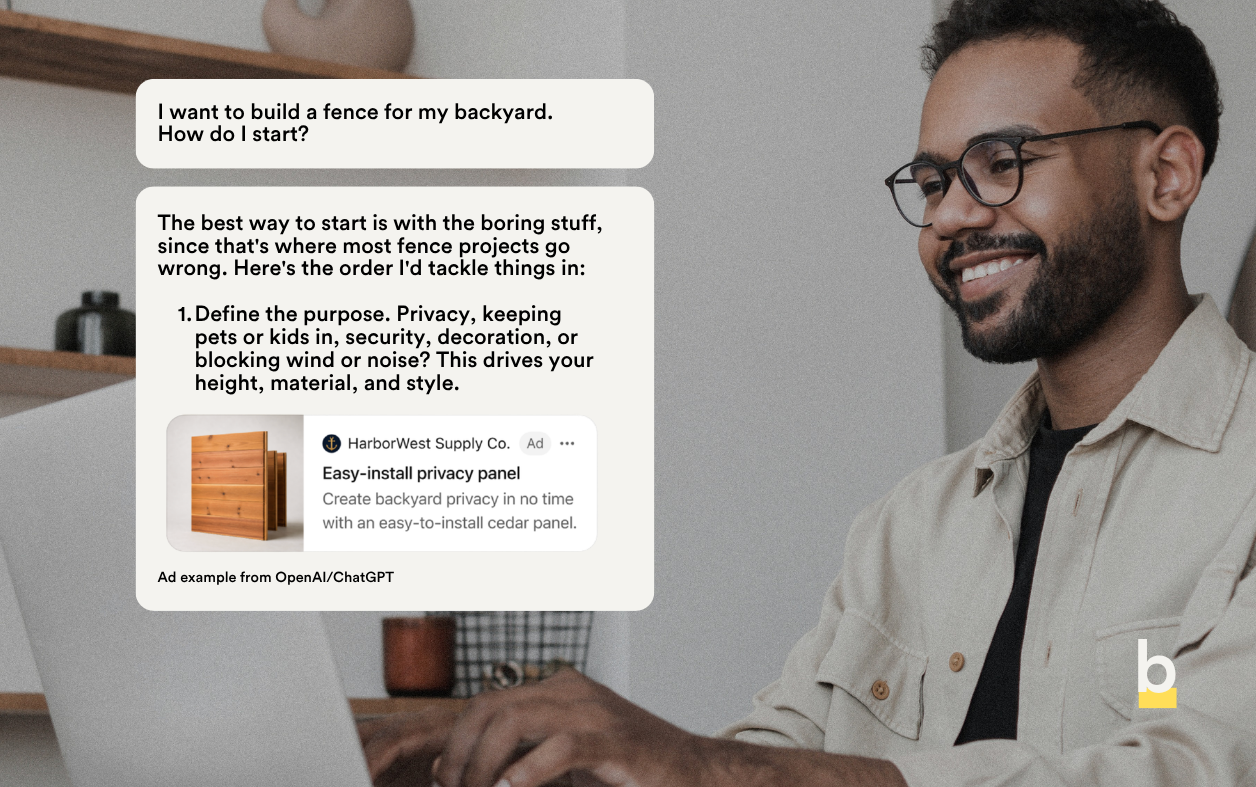
ChatGPT ads are paid placements that appear inside ChatGPT conversations. They are not part of ChatGPT's answer. Ads can appear below the end of a response, are labeled as sponsored, and are visually separated from the answer. The format is closer to a search ad than a chatbot recommendation, but it is triggered by the topic of a conversation rather than a typed keyword.
Where Ads Appear and Who Sees Them
OpenAI first said it would test ads for the free and Go tiers in the U.S., while Plus, Pro, Business, and Enterprise subscriptions would not include ads. The test began in the US on February 9, 2026. OpenAI later said it would expand beyond the U.S., starting with pilots in Canada, Australia, and New Zealand. Its most recent update says ads are available in over 40 countries.
In terms of the ad layout, the main format is a "chat card": a sponsored card below the AI response with a title, short description, image, and destination link.
How Ads Relate to Answers and Privacy
OpenAI's central promise is separation. Ads run on separate systems from the chat model, and advertisers cannot shape, rank, or alter ChatGPT's responses. On privacy, OpenAI says advertisers do not have access to chats, chat history, memories, or personal details. OpenAI also says users can control how their ad experience is personalized.
Ad selection does draw on context. During the test, OpenAI matched advertiser submissions with the topic of the conversation, past chats, and past interactions with ads.
ChatGPT Ads News: A Timeline of the Rollout
If you're following OpenAI ads ChatGPT news, the pace has been fast. The main milestones are below.
From Announcement to Launch
OpenAI announced its plan alongside the U.S. launch of ChatGPT Go, its low-cost tier, arguing that ads could help more people benefit from its tools with fewer usage limits or without having to pay. The pilot began in February 2026. It started with a small group of advertisers, and early access was reportedly expensive. One source describes a $200,000 enterprise pilot.
Self-Serve and Global Expansion
In the first phase, advertisers bought on a CPM (cost-per-thousand impressions) basis. OpenAI then introduced a beta self-serve Ads Manager, cost-per-click bidding, and expanded measurement tools. That opened the platform to small and mid-sized businesses. OpenAI now says CPC and outcome-optimized bidding account for the majority of campaigns. It has also launched self-serve access across India, Europe, the Middle East, and North Africa.
AI Tools for Building Ads
The newest updates are about making campaigns easier to build. Advertisers can use natural-language prompts to create, update, and analyze campaigns directly in ChatGPT with the Ads Manager platform. Ads Manager also offers suggested copy and imagery based on the landing page and campaign objective, and advertisers can review and edit suggestions before using them. US-based Shopify merchants can now use a ChatGPT Ads app to create and manage campaigns, with international availability planned from September 23.
How ChatGPT Ads Work for Advertisers
The workflow will feel familiar to anyone who has run Google or Meta campaigns. Businesses register, add payment information, set budgets, bids, and pacing, upload ads, and manage campaigns in the portal. The differences are in targeting and measurement. OpenAI
Targeting by Conversation Context
Instead of bidding on keywords, advertisers describe the kinds of conversations where their ad should be eligible. Agencies call these prompts or "context hints." One practitioner notes that audience lists refine who can see your ads, but prompts still determine the conversations where the ads are eligible to appear. OpenAI also lists product feeds, platform and geographic targeting, and custom audiences among its more advanced capabilities.
Bidding and Measurement
Measurement started weak. Several outlets described broken or missing Ads Manager reporting during the pilot. That has improved. OpenAI says Pixel and Conversions API have become important foundations for measurement and optimization. Even so, treat any reported return as attributed, not proven incremental, until you've run a holdout test.
Costs and Benchmarks
Numbers vary, and most come from agencies with something to sell, so read them as directional. One guide puts CPCs at $2.50–$8.00, above Google Search's $1–3. A small wellness campaign reported 397 clicks at $2.87 CPC and 22 leads at a blended $52 per lead over six weeks. Another analysis notes that a 0.91 percent click-through rate is not comparable to Google Search's 6.4 percent, because the surface produces conversation, not clicks.
Examples of Good ChatGPT Ads
Public creative libraries are thin, and OpenAI hasn't published a gallery of best-performing ads. The examples below are illustrative mock-ups I wrote, not real ads. Each follows the chat-card structure (title, short description, call to action) and matches a pattern that agencies and OpenAI describe as working.
ChatGPT Ads Example 1: The Meal Kit Ad (Matching a Task)
Conversation: A user asks for weeknight dinner ideas for two people.
Ad: Fresh Table Meal Kits. "Dinner for two in 25 minutes." Chef-designed recipes, pre-portioned ingredients, delivered weekly. Get 50% off your first box.
Why it works: It mirrors OpenAI's own example, where someone researching recipes may see ads for meal kits or grocery delivery. The ad solves the exact task the user is working on. It doesn't interrupt the conversation, it extends it.
ChatGPT Ads Example 2: The B2B Demo Ad (Matching Buying Intent)
Conversation: A user asks how to choose inventory forecasting software for a mid-sized distributor.
Ad: StockSense Forecasting. "See your demand forecast in 15 minutes." Built for distributors with 500+ SKUs. Book a live demo.
Why it works: The offer fits the stage of the conversation. One agency reports reserving direct-response offers like demos for buyers who appeared ready to speak with sales, and giving broader researchers helpful content instead. The same agency reports leads at less than half of what they were paying on Google. That is a self-reported claim, so validate it in your own account.
ChatGPT Ads Example 3: The Product-Feed Ad (Matching a Comparison)
Conversation: A user compares robot vacuums for a home with pets.
Ad: Aerobot P7. "Built for pet hair." Self-emptying dock, 120-minute runtime, tangle-free brush. From $449. See specs.
Why it works: Comparison shoppers want specifics: price, features, and a reason to choose one option. OpenAI says product feeds are now part of the platform, which lets retail advertisers keep this kind of detail accurate at scale.
ChatGPT Ads Example 4: The Service Ad With Built-In Screening
Conversation: A user asks how to manage stress and burnout at work.
Ad: Calm Practice Online. "1:1 sessions from home." Licensed practitioners over Zoom. Book a free 15-minute intro call.
Why it works: The landing page matters as much as the ad. The wellness case study above built screening questions into the funnel, so only prospects ready to start and comfortable with Zoom sessions reached the calendar, and offered a free eBook to visitors who weren't ready to book.
What These Examples Have in Common
Each ad is specific to the task, makes one clear promise, and matches the visitor's stage. None of them read like a banner ad dropped into a chat. In a conversational setting, relevance is the whole game.
Tips for Writing ChatGPT Ads That Perform
- Write for the question, not the keyword. Think about what someone types in a full sentence, including their constraints ("for two people," "with pets," "under $500").
- Lead with the outcome. A short, concrete benefit beats brand slogans.
- Match offer to intent. Use demos and discounts for ready buyers. Use guides and comparisons for researchers.
- Send people to a real landing page. Give researchers comprehensive pages with videos, case studies, comparisons, and FAQs, plus clear next steps without aggressive conversion pressure. Ryze AI
- Exclude irrelevant conversations. Carry over exclusions for employees, job seekers, and other audiences unlikely to convert.
- Measure incrementality. Compare against a holdout so you know the ad created demand rather than just claiming credit for it.
Limits and Criticisms
Ads in ChatGPT face real skepticism. Users trust chatbots with personal problems, so any hint that commercial interests shape answers could damage that trust. OpenAI stresses that seeing an ad doesn't mean OpenAI endorses or recommends the advertiser. For marketers, the pain points are thin public benchmarks, evolving measurement, and higher CPCs than search. Custom audiences also come with list-size requirements, so they're currently much more useful for enterprise advertisers than for small and mid-sized businesses.
FAQs About ChatGPT Ads
Do ads change the answers ChatGPT gives me?
According to OpenAI, no. It states that ads do not influence ChatGPT's answers, and that ads run on separate systems from the chat model. In practice, the model writes its response first, and a separate system decides whether a relevant ad fits below it. Advertisers can't pay to rank higher in an answer, reword a recommendation, or get their brand named in the text. That said, you should still treat sponsored cards as advertising. A sponsored placement is not an endorsement, and it's worth comparing the option against other sources before you buy, exactly as you would with a search ad.
Who sees ads in ChatGPT, and can I avoid them?
Ads are aimed at people on lower-cost tiers. OpenAI says the Plus, Pro, Business, and Enterprise subscriptions will not include ads, so upgrading to one of those plans is the clearest way to avoid them. Free and Go users are the audience for ads. OpenAI also says users can control how their ad experience is personalized, which means you can limit how much your activity informs which ads you see, even if you can't remove ads entirely on a free plan. Availability also depends on your country, since the rollout has been expanding market by market.
How much do ChatGPT ads cost?
There is no single price. The pilot began with CPM pricing, and OpenAI has since added CPC and outcome-optimized bidding, which now account for the majority of campaigns. Third-party guides estimate CPCs between roughly $2.50 and $8.00, but those figures come from agencies and shift quickly as more advertisers join. Cost per lead also depends on your offer, funnel, and category. One wellness advertiser reported about $52 per lead, while a B2B agency claimed costs below half of Google's. The safest approach is to start with a modest test budget and judge results against your own margins.
How do advertisers target people in ChatGPT?
Targeting is built on conversation context rather than keywords or profiles. Advertisers describe the topics and questions where they want to appear, and OpenAI's system matches those to live conversations. OpenAI also offers product feeds, platform and geographic targeting, and custom audiences to narrow reach further. Importantly, advertisers don't see the conversations themselves. Advertisers do not have access to chats, chat history, memories, or personal details. Advertisers get performance data such as impressions, clicks, and conversions, not the underlying text of anyone's chat.
Are ChatGPT ads worth it compared to Google Ads?
It depends on your category and goals. ChatGPT ads reach people in research and decision mode, which is attractive for considered purchases such as software, electronics, home goods, and services. Reported results are promising but early. One widely cited account returned $89,000 on $60,000 of spend over 15 days, a 1.49x blended ROAS, but without incrementality testing. Costs per click also run higher than search, and reporting is still maturing. Most marketers treat ChatGPT ads as a test channel alongside search rather than a replacement. Start small, track conversions with Pixel or the Conversions API, and scale only if results hold up against a holdout.
Learn about our GEO approach
Generative Engine Optimization from Butter
AI engines like ChatGPT are changing how people discover products and services. Instead of showing ten blue links like Google, they generate direct answers, pulling from trusted sources across the web. This guide breaks down how Butter’s GEO service helps your website become one of those trusted sources.
Budget-friendly GEO & SEO services
GEO
Reliable managed GEO to help your business show up in generative engines.
$399/mo
.png)
GEO+SEO
Everything in the GEO plan, plus managed full-service search engine optimization.
$799/mo
.png)
AI visibility & search marketing add-ons
Public Relations
$299
AI Ads
$399
Social Media
$499

Butter saves me stress and frees up 50% of my time to focus on growing my new business.
Khaled A., Owner at Sebala Assisted Living
Join the websites already partnering with Butter for GEO and SEO
Show up in Google, ChatGPT, and AI search with Butter's GEO + SEO services. Starting at $399/month. No contract options. Cancel anytime.