
How to Track Your Rankings and Visibility on Perplexity
How to track your rankings, citations, and brand mentions on Perplexity, including tools, methods, and what to measure.


Perplexity has become one of the fastest-growing AI answer engines, and for a lot of users, it's replaced Google as the first place they go with a question. Unlike a traditional search engine, Perplexity gives a single synthesized answer built from a handful of cited sources — which means "ranking" on Perplexity doesn't look anything like ranking on Google. There's no page one, no ten blue links, no obvious position to check.
That's exactly why Perplexity rank tracking has become a priority for SEO teams and content marketers. If your brand, product, or content isn't showing up — or isn't being cited — in Perplexity's answers, you have almost no way of knowing unless you're actively tracking it.
This guide covers what Perplexity rank tracking actually means, why it matters, and how to build a reliable process for monitoring your visibility over time.
What Is Perplexity Rank Tracking?
Perplexity rank tracking is the process of monitoring how often, how prominently, and in what context your website, brand, or content appears in Perplexity's AI-generated answers. Instead of tracking a numbered position in a results list, rank tracking on Perplexity focuses on a different set of signals: whether your domain is cited as a source, where that citation appears relative to others, how frequently your brand is mentioned across a set of relevant queries, and how accurately Perplexity represents your content when it does show up.
Because Perplexity pulls from live web sources and displays citations directly in its answers, it's technically more transparent than some other AI tools — but that transparency only helps if you're actually checking it. Rank tracking turns that raw visibility into something measurable and repeatable.
How It Differs From Traditional SEO Rank Tracking
Traditional rank trackers monitor a fixed position — position 3 for "best running shoes," for example — across a stable results page structure. Perplexity's answers are dynamic. The same query can return different sources, different framing, and even different length responses depending on when it's asked, what's been recently published, and how the model interprets the question. This means Perplexity rank tracking has to account for variability in a way that classic SEO tracking doesn't, often requiring more frequent checks and a focus on trends rather than single snapshots.
Why Track Perplexity Search Engines
Perplexity's User Base Skews High-Intent
Perplexity has built a reputation among researchers, professionals, and increasingly mainstream users looking for accurate, well-sourced answers rather than a page of links to sift through. Users who choose Perplexity over a traditional search engine tend to be doing deeper research, which often correlates with higher purchase or decision intent. Missing visibility here can mean missing some of the most valuable traffic in your funnel.
Citations Function Like a New Kind of Backlink
Every time Perplexity cites your page as a source, it's effectively vouching for your content's credibility to the user reading the answer. Over time, patterns in which pages get cited — and which don't — reveal a lot about what kind of content Perplexity's retrieval system considers trustworthy and relevant. Tracking this gives you a roadmap for what to create or improve.
It's Still Early, Which Is an Advantage
Because most brands aren't yet tracking their Perplexity visibility closely, there's an opportunity to build a lead before the space becomes as competitive as traditional SEO. Teams that start monitoring and optimizing now are more likely to establish a strong citation presence before more competitors catch on.
How to Track Keyword Rankings on Perplexity
Build a Keyword and Query List
Start with the queries that matter most to your business — not just branded terms, but the informational and comparison queries your potential customers are likely to ask. Group them by intent (informational, comparison, transactional) so you can analyze patterns within each category rather than treating all results the same way.
Query Perplexity Consistently
Run your query list against Perplexity on a fixed schedule, ideally weekly or biweekly. Use the same phrasing each time so you're comparing consistent inputs, since even small wording changes can shift which sources Perplexity pulls from.
Record Citation Position and Frequency
For each query, note whether your domain appears among the cited sources, where it falls in the citation order, and how many total sources were cited. A domain that consistently appears as the first or second citation carries more visibility weight than one that occasionally appears near the bottom of a long source list.
Watch for Featured Snippets Within Answers
Sometimes Perplexity will quote or closely paraphrase a specific sentence or statistic from your page directly within its answer. This is a strong visibility signal worth tracking separately, since it means your content isn't just cited — it's actively shaping the answer text itself.
Best Online Perplexity Rank Tracker Options
Dedicated AI Search Tracking Tools
A growing number of tools are built specifically to automate Perplexity (and broader AI search) rank tracking, running large batches of queries on a schedule and reporting citation frequency, position, and share of voice against competitors in a dashboard. These are the most scalable option for teams tracking dozens or hundreds of queries.
Free Perplexity Rank Tracking Methods
For teams not ready to invest in a dedicated tool, free tracking is possible with a manual process: maintain a spreadsheet of target queries, run them through Perplexity on a set schedule, and log citation appearances, position, and any notable paraphrasing by hand. It's more time-intensive, but it's a reasonable way to validate whether deeper investment in automated tracking is worthwhile.
Browser Extensions and Lightweight Scripts
Some teams build lightweight internal scripts using Perplexity's API to automate query submission and citation logging, which can bridge the gap between fully manual tracking and a paid platform, especially for teams with some technical resources but limited budget.
Rank Tracker Tool Perplexity: What to Look For
Query Volume and Scheduling Flexibility
A good tracking tool should let you run a large, customizable list of queries on a recurring schedule automatically, rather than requiring manual re-entry every time you want fresh data.
Competitor Comparison
The most useful tools let you track your own citation performance alongside two or three direct competitors across the same query set, since relative visibility is often more actionable than an isolated view of your own numbers.
Historical Trend Reporting
Because Perplexity's answers shift over time as new content is published and indexed, a tracker that only shows a current snapshot is far less useful than one that maintains historical data, letting you see whether your visibility is trending up or down and correlate that with specific content or SEO changes you've made.
Source and Content Analysis
The strongest tools go beyond simple position tracking and analyze why certain pages get cited — looking at content format, structure, freshness, and authority signals — so you can apply those insights to your own content strategy.
How to Track Brand Mentions in Perplexity
Separate Branded Queries From Category Queries
Branded queries — searches that already include your company or product name — will naturally surface your own content more often. To get a true read on visibility, track category and comparison queries separately, since these reveal whether Perplexity considers you relevant even when users aren't already looking for you specifically.
Monitor Sentiment and Framing
When your brand is mentioned, pay attention to how it's described — as a leader, an alternative, a budget option, or something else. This framing shapes user perception just as much as whether you're mentioned at all, and it's often driven by the specific source Perplexity is citing.
Check for Outdated or Incorrect Information
Because Perplexity draws on live web content, it can sometimes cite outdated pages with old pricing, discontinued features, or inaccurate comparisons. Flagging these instances is important, both so you can work on getting fresher content indexed and so you understand where user-facing misinformation about your brand might be coming from.
Why Track Perplexity Rankings
It Reveals Content Gaps
Consistently low or absent visibility for certain query categories often points to a genuine content gap — topics your competitors have covered thoroughly and you haven't. Rank tracking surfaces these gaps in a way that's hard to see through traditional SEO tools alone, since Perplexity's citation patterns don't always mirror standard search rankings.
It Connects Content Strategy to Measurable Outcomes
Publishing new content or updating existing pages without a feedback loop makes it hard to know what's actually working. Tracking Perplexity rankings before and after content changes gives you a direct signal on whether your efforts are improving your citation visibility, closing the loop between content strategy and measurable results.
It Helps You Benchmark Against Competitors
Understanding where you stand relative to competitors in Perplexity's answers helps prioritize where to focus. If a competitor consistently outranks you on comparison queries but not on how-to queries, that's a clear signal about where the content gap actually is.
Building a Perplexity Rank Tracking Routine
A sustainable approach combines a consistent query list, a regular tracking cadence, and a clear process for acting on what you find. Most teams do well starting with a core list of 20 to 50 priority queries, checking them on a biweekly or monthly basis, and reviewing results alongside their broader content calendar. As visibility data accumulates, patterns emerge — certain content formats, page structures, or topics that consistently earn citations — and those patterns should directly inform what gets created or updated next.
Perplexity Ranking Tracking: Frequently Asked Questions
Why track Perplexity search engines?
Tracking Perplexity matters because it has grown into one of the most-used AI answer engines among a highly engaged, research-oriented user base, and its citation-based answer format means visibility works completely differently than it does on traditional search engines. Users turning to Perplexity are often further along in a research or decision-making process, which means the traffic and attention available through strong Perplexity visibility can be especially valuable. Because Perplexity displays its sources directly within each answer, it also offers a level of transparency that makes tracking genuinely actionable — you can see exactly which pages are being cited and use that information to guide content strategy. Without active tracking, however, none of this transparency is useful, since there's no ranking page to casually check the way there is with Google. Regular tracking turns Perplexity from an opaque, unpredictable channel into a measurable part of your visibility strategy, and given how early most brands still are in adopting this practice, it also represents a meaningful opportunity to build a citation advantage before the space becomes more competitive.
How do you track brand mentions in Perplexity?
Tracking brand mentions in Perplexity starts with building a list of relevant queries that go beyond just your brand name — category questions, comparison questions, and problem-based questions that reflect how real users search when they haven't already decided which company to choose. Run these queries consistently, using identical phrasing each time, and log whether your brand is mentioned, where it appears relative to competitors, and what tone or framing is used to describe it. It's also worth separately tracking whether your domain appears among the cited sources, since a citation carries more weight than a passing mention within the generated text. Pay close attention to accuracy as well; because Perplexity pulls from live web content, mentions can sometimes reflect outdated pricing, discontinued features, or incorrect claims, and catching these early lets you address them before they influence a potential customer's decision. Doing this consistently, on a fixed schedule such as weekly or biweekly, is what turns a one-time check into a genuine tracking process capable of revealing trends over time.
How do you track Perplexity visibility?
Tracking Perplexity visibility means measuring not just whether your brand or content appears in Perplexity's answers, but how consistently and prominently it does so across a meaningful set of relevant queries. The process starts with defining a query list grouped by intent — informational, comparison, and transactional — since visibility patterns often differ significantly across these categories. From there, queries should be run on a consistent schedule, with results logged for citation appearance, citation position, and total number of sources cited in each answer, since a domain cited first among two sources carries very different weight than one cited last among ten. Some teams also track whether Perplexity directly quotes or closely paraphrases specific content from their pages, which is a stronger visibility signal than a general citation alone. Because Perplexity's answers can shift as new content is published and indexed, visibility tracking works best as an ongoing process rather than a single audit, with results reviewed over time to spot trends, connect them to specific content changes, and continuously refine what content is created or updated next.
Why track Perplexity rankings?
Tracking Perplexity rankings gives you visibility into a part of the buyer or research journey that would otherwise be completely invisible, since there's no traditional results page to check and no way to know whether you're being cited without actively looking. This tracking reveals genuine content gaps — topics where competitors are consistently earning citations and you aren't — in a way that traditional SEO tools often miss, since Perplexity's citation patterns don't always mirror standard search engine rankings. It also creates a feedback loop between your content efforts and measurable outcomes; without tracking, it's difficult to know whether updating a page, publishing new content, or improving structured data actually moved the needle on your AI visibility. Beyond that, tracking rankings against competitors helps clarify where to prioritize effort, since a consistent gap in one query category, such as comparison content, points to a specific and addressable weakness. Altogether, ranking data turns AI visibility from a vague concern into a concrete, trackable metric that can directly inform content and SEO strategy.
How do you track keyword rankings on Perplexity?
Tracking keyword rankings on Perplexity involves treating each target query as a repeatable test rather than a one-time search, since Perplexity's dynamic, citation-based answers require consistency to produce meaningful trend data. Start by building a query list organized by topic and intent, then run each query through Perplexity on a fixed schedule using identical phrasing, since even minor wording changes can shift which sources get pulled into the answer. For each query, record whether your domain is cited, its position among the cited sources, and the total number of sources in the response, since these details together paint a much clearer picture than a simple yes-or-no mention check. It's also useful to track any instances where Perplexity closely paraphrases or quotes specific content from your pages, as this indicates a deeper level of influence on the actual answer text rather than just a passing citation. This can be done manually with a spreadsheet for smaller query sets, or through a dedicated rank tracking tool for teams monitoring dozens or hundreds of keywords, but either way, the value comes from consistent, repeated tracking over time rather than isolated checks.
Learn about our GEO approach
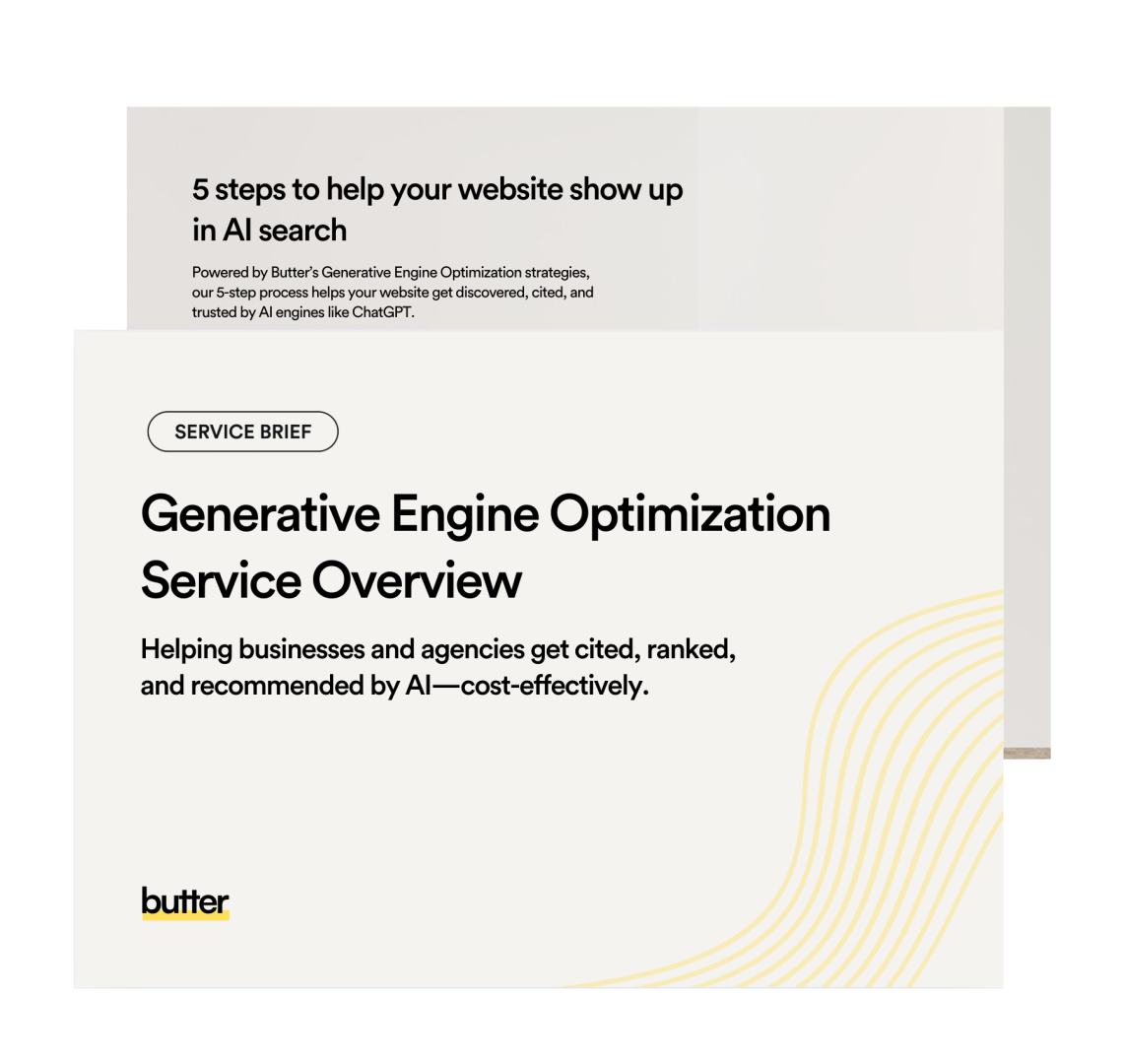
Generative Engine Optimization from Butter
AI engines like ChatGPT are changing how people discover products and services. Instead of showing ten blue links like Google, they generate direct answers, pulling from trusted sources across the web. This guide breaks down how Butter’s GEO service helps your website become one of those trusted sources.
Budget-friendly GEO & SEO services
GEO
Reliable managed GEO to help your business show up in generative engines.
$399/mo
.png)
GEO+SEO
Everything in the GEO plan, plus managed full-service search engine optimization.
$799/mo
.png)
AI visibility & search marketing add-ons
Public Relations
$299
AI Ads
$399
Social Media
$499

Butter saves me stress and frees up 50% of my time to focus on growing my new business.
Khaled A., Owner at Sebala Assisted Living
Join the websites already partnering with Butter for GEO and SEO
Show up in Google, ChatGPT, and AI search with Butter's GEO + SEO services. Starting at $399/month. No contract options. Cancel anytime.