
How to E-E-A-T for AI Search
Discover how E-E-A-T applies to AI search engines like ChatGPT and Claude, and the specific trust signals that determine whether AI models cite your content.


For years, E-E-A-T — Experience, Expertise, Authoritativeness, and Trustworthiness — has been the backbone of how Google evaluates content quality. It wasn't a ranking algorithm itself, but a framework baked into how Google's Quality Rater Guidelines assessed whether a page deserved to rank, especially for topics that affect health, finances, or safety.
Now that AI models are answering questions directly — pulling from, summarizing, and citing web content in real time — a natural question has emerged: does E-E-A-T still matter? The answer is yes, but the mechanics have changed. AI models don't have human quality raters reading your About page. Instead, they infer trust from patterns: structured signals, corroboration across sources, author identity, citation behavior, and consistency. Understanding these patterns is the foundation of Generative Engine Optimization (GEO).
This article breaks down exactly which trust signals large language models weigh most heavily, why they matter differently than they did for classic SEO, and how to strengthen each one on your own site.
Why E-E-A-T Looks Different to an AI Model
Google's original E-E-A-T framework was built around a simple idea: content that could harm someone if it's wrong — medical advice, financial guidance (financial advisors), legal information — deserves extra scrutiny. Human raters were trained to look for author credentials, site reputation, and citations to back up claims.
AI models operate under similar pressure but with a different mechanism. Large language models are trained to avoid confidently repeating misinformation, so they've developed (and been fine-tuned toward) heuristics for weighing source reliability. When a model like ChatGPT or Claude retrieves content to answer a query, it's implicitly asking: is this source likely to be accurate, and can I attribute this claim safely?
That means trust signals now have to be machine-legible, not just human-persuasive. A beautifully written author bio buried in a footer might convince a human reader — but if it's not structured in a way a crawler or retrieval system can parse, it does nothing for GEO.
The Shift from Ranking Signals to Retrieval Signals
Classic SEO trust signals (backlinks, domain age, page authority) still play a role because many AI systems use search indexes as part of their retrieval pipeline. But generative engines add a second layer: once a source is retrieved, the model has to decide whether to actually use it, how to phrase the claim, and whether to cite it explicitly. This second layer rewards clarity, corroboration, and verifiable specificity over generic authority.
The Trust Signals AI Models Weigh Most
1. Clear, Verifiable Authorship
AI models are increasingly sensitive to who is making a claim. Content with a named author, a real bio, and demonstrable subject-matter background is more likely to be treated as credible than anonymous or generically bylined content.
This matters even more for YMYL (Your Money or Your Life) topics — health, finance, law — where models are tuned to be cautious. A named cardiologist writing about heart health carries more retrieval weight than an unattributed "admin" post making the same claim.
How to strengthen this:
- Add real author bylines with credentials relevant to the topic
- Link author names to a bio page with schema markup (
Personschema) - Keep author information consistent across your site and any external profiles (LinkedIn, professional directories)
2. Corroboration Across Independent Sources
This is arguably the single biggest shift from traditional SEO. Google's algorithm could reward a single authoritative page ranking #1. AI models, by contrast, often synthesize an answer by checking whether multiple independent sources agree.
If your claim about a statistic, a best practice, or a product feature appears nowhere else on the web, a model may hesitate to state it confidently or cite it at all — even if your page ranks well. Conversely, claims that are echoed (in your own words, not duplicated) across several credible sources tend to get folded into AI answers more readily.
How to strengthen this:
- Publish original data or research that other sites can reference and corroborate
- Get cited or mentioned by industry publications, not just linked
- Ensure your key claims are consistent with what's stated elsewhere about your brand (inconsistent facts across the web erode trust signals)
3. Structured, Extractable Content
AI models parse content more like a retrieval system than a human skimmer. Clear headings, direct answers near the top of a section, defined terms, and logically ordered information are far easier for a model to extract and attribute accurately.
Dense, meandering prose with the actual answer buried in paragraph four is a liability — not because it's poorly written, but because it's harder for a retrieval system to isolate as a clean, quotable claim.
How to strengthen this:
- Answer the core question in the first 1-2 sentences of a section
- Use descriptive H2s and H3s that mirror how people actually ask questions
- Use lists, tables, and definitions where appropriate rather than long unbroken paragraphs
4. Freshness and Update Signals
AI models are wary of stale information, especially for fast-moving topics like pricing, regulations, statistics, or technology. Visible "last updated" dates, versioned content, and timestamps in structured data help models judge whether a claim is still current.
This doesn't mean you need to rewrite everything monthly — but a page that hasn't been touched in three years, on a topic where facts change, will be treated with more skepticism than one showing recent maintenance.
How to strengthen this:
- Display a visible "last updated" date on time-sensitive content
- Use
dateModifiedin your schema markup - Periodically refresh statistics, pricing, and examples rather than leaving them to go stale
5. Domain and Brand Reputation Signals
Just as with traditional SEO, the reputation of the domain itself still matters — but it's less about raw backlink count and more about how your brand is discussed across the web. AI models pick up on sentiment and context: is your brand mentioned alongside credible peers? Are third-party reviews and mentions generally positive and specific?
This is sometimes called "brand entity strength" in GEO circles. A brand that's discussed consistently, with the same facts and positioning across many independent sources, becomes easier for a model to recognize as a stable, trustworthy entity.
How to strengthen this:
- Pursue earned mentions in industry publications, not just guest posts
- Maintain a consistent brand description and value proposition across your website, social profiles, and third-party listings
- Monitor and correct inaccurate information about your brand where it appears online
6. Technical Trust Markers
Some trust signals are almost invisible to human readers but highly legible to machines: HTTPS, schema.org structured data, clean HTML semantics, and the absence of manipulative patterns like cloaking or keyword stuffing.
These don't build trust on their own, but their absence can actively undermine it. A site with broken markup, mixed content warnings, or intrusive ad patterns signals lower quality to both crawlers and the ranking systems that feed AI retrieval pipelines.
How to strengthen this:
- Implement relevant schema types (
Article,FAQPage,Person,Organization) - Ensure your site is fully HTTPS with no mixed-content issues
- Keep page structure clean — avoid excessive pop-ups, intrusive interstitials, or thin affiliate content
7. Citation-Worthy Specificity
Generic, vague claims ("many experts agree that...") are far less likely to be cited than specific, attributable ones ("a 2025 survey of 1,200 marketers found that..."). AI models favor content that gives them something concrete to point to — a number, a named source, a specific method — because it's both more useful to the end user and easier to attribute responsibly.
How to strengthen this:
- Cite your own sources, studies, and data within your content
- Replace vague qualifiers with specific figures, dates, and named references
- When possible, be the original source of a statistic or framework, not just a repeater of one
How E-E-A-T Changes Content Strategy
Taken together, these signals suggest a content strategy that looks different from classic SEO-first writing. Instead of optimizing primarily for keyword density and backlink acquisition, GEO-aware content strategy prioritizes:
- Originality over repetition — being the source that gets corroborated, not just another page saying the same thing
- Structural clarity over stylistic flourish — content that's easy to extract cleanly
- Verifiable expertise over generic authority — real people, real credentials, real specificity
- Cross-web consistency over isolated optimization — your brand's facts need to agree with themselves everywhere they appear
None of this replaces good SEO fundamentals. Technical health, site speed, and crawlability still matter because AI systems often rely on the same underlying web infrastructure that search engines do. But GEO adds a layer on top: once you're found, will a model trust you enough to use you?
E-E-A-T FAQs
Is E-E-A-T an official Google ranking factor, and does it apply to AI search the same way?
E-E-A-T itself was never a direct, single ranking factor in Google's algorithm — it originated as part of the Search Quality Rater Guidelines, the framework human evaluators use to assess content quality, particularly for YMYL (Your Money or Your Life) topics like health, finance, and legal advice. Google has stated that these guidelines inform how the algorithm is trained and evaluated over time, rather than functioning as a checklist the algorithm scores directly.
In the context of AI search, the underlying goals of E-E-A-T — surfacing accurate, credible, well-sourced content — remain highly relevant, but the mechanism is different. AI models don't have human raters reading your page in real time; instead, they rely on patterns learned during training and retrieval-time heuristics to judge source reliability. This means the spirit of E-E-A-T (demonstrating real expertise, verifiable authorship, and trustworthy sourcing) still matters enormously for AI visibility, but the specific tactics for demonstrating it need to be machine-legible: structured data, consistent factual claims across the web, and clear attribution, rather than just well-written human-facing trust signals.
How is GEO different from traditional SEO in practice?
Traditional SEO is primarily about optimizing to rank in a list of links, where the user then clicks through to your site to get their answer. Success is measured in rankings, click-through rate, and organic traffic. GEO, by contrast, is about optimizing to be the source an AI model draws from, paraphrases, or cites when generating a direct answer — and success is measured more in terms of visibility within AI-generated responses, brand mentions, and referral traffic from AI platforms, which often behaves differently than traditional search traffic.
Practically, this changes several priorities: GEO places heavier emphasis on being corroborated by other independent sources (since AI models often cross-reference multiple sources before stating a claim confidently), on structuring content so specific facts can be cleanly extracted, and on maintaining consistent, verifiable facts about your brand across the entire web rather than just optimizing a single page.
That said, GEO and SEO are not competing disciplines — strong technical SEO (crawlability, site speed, structured data, mobile-friendliness) remains foundational, because most AI systems still rely on underlying search infrastructure to discover and retrieve content in the first place. Think of GEO as an additional layer of optimization built on top of solid SEO fundamentals, not a replacement for them.
What specific schema markup helps AI models trust and cite my content?
Structured data doesn't guarantee citation, but it gives AI systems clearer, unambiguous signals about what your content is and who's behind it, which supports the trust-inference process. The most valuable schema types for GEO purposes include Article or BlogPosting schema, which clearly marks a piece as original editorial content and can include fields like datePublished, dateModified, and author; Person schema for author bios, which can link a named writer to their credentials, job title, and other published work, reinforcing the "real expert wrote this" signal; Organization schema, which helps establish your brand as a defined, legitimate entity rather than an anonymous domain; FAQPage schema, which structures question-and-answer content in a format that's especially easy for generative engines to lift directly into a synthesized answer; and Review or AggregateRating schema where applicable, which can reinforce third-party validation.
None of these work in isolation — the real value comes from consistency between what your schema claims and what a model can independently verify elsewhere on the web (for example, an author's bio matching their LinkedIn profile and other bylines). Schema is best understood as making your existing trust signals legible to machines, not manufacturing trust signals that don't otherwise exist.
Can small businesses or niche sites realistically compete for AI citations against large, established brands?
Yes, and in some ways the AI search landscape can actually favor smaller, specialized sites more than traditional SEO did. Because generative engines often prioritize specificity, originality, and demonstrable first-hand expertise over sheer domain authority or backlink volume, a niche site with deep, well-documented experience in a narrow topic can outperform a large generic site that covers the same subject superficially.
For example, a small specialty clinic's page on a rare condition, written by the actual treating physician with specific case details and outcomes, may be judged more trustworthy by an AI model than a broad health portal's generic overview of the same condition — because it demonstrates genuine first-hand experience, which is exactly the "Experience" component E-E-A-T was designed to capture. The practical path for smaller sites is to lean into what large competitors often can't easily replicate: original data from your own operations, detailed first-hand case studies, named expert authorship, and hyper-specific answers to narrow questions. Combined with basic technical hygiene (schema markup, HTTPS, clean structure), this can make a small site a disproportionately attractive source for AI retrieval systems, even without the backlink profile of a much larger competitor.
How can I actually measure whether AI models are citing or trusting my content?
Measuring AI citation is still an emerging practice compared to the mature analytics tooling available for traditional SEO, but there are several practical approaches. First, manually query AI tools like ChatGPT, Perplexity, Google AI Overviews, and Claude with questions relevant to your core topics and note whether your brand, site, or specific content is mentioned or cited — this qualitative spot-checking, done regularly, is one of the most direct signals available today.
Second, monitor referral traffic in your analytics platform for sessions originating from AI tools; most major platforms (Perplexity, ChatGPT with browsing, Google AI Overviews) do pass some referral traffic, and a growing number of analytics tools now let you segment "AI referral" traffic specifically.
Third, watch for third-party mentions and citations of your brand across the web more broadly, since corroboration across independent sources is itself a trust signal that feeds back into AI retrieval — tools built for digital PR and brand monitoring (mention tracking, backlink monitoring with alerts) can help here even though they weren't built specifically for GEO.
Finally, a growing category of dedicated GEO/AI-visibility tools has emerged that specifically track how often a brand or domain appears in AI-generated answers across multiple platforms and query sets, offering something closer to a "rank tracker" for AI citations — though this category is still maturing and methodologies vary between vendors, so results should be treated as directional rather than definitive.
Learn about our GEO approach
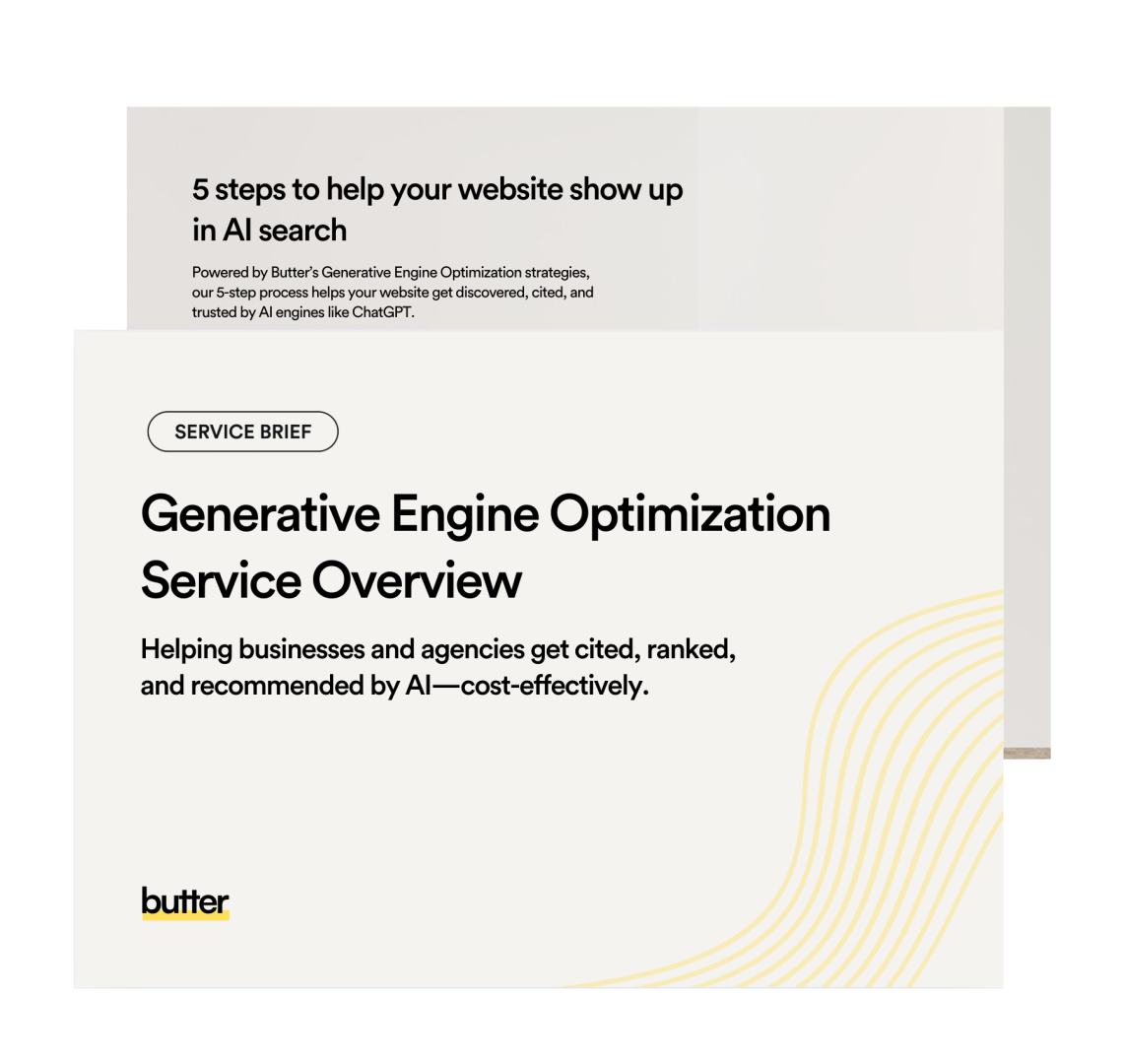
Generative Engine Optimization from Butter
AI engines like ChatGPT are changing how people discover products and services. Instead of showing ten blue links like Google, they generate direct answers, pulling from trusted sources across the web. This guide breaks down how Butter’s GEO service helps your website become one of those trusted sources.
Budget-friendly GEO & SEO services
GEO
Reliable managed GEO to help your business show up in generative engines.
$399/mo
.png)
GEO+SEO
Everything in the GEO plan, plus managed full-service search engine optimization.
$799/mo
.png)
AI visibility & search marketing add-ons
Public Relations
$299
AI Ads
$399
Social Media
$499

Butter saves me stress and frees up 50% of my time to focus on growing my new business.
Khaled A., Owner at Sebala Assisted Living
Join the websites already partnering with Butter for GEO and SEO
Show up in Google, ChatGPT, and AI search with Butter's GEO + SEO services. Starting at $399/month. No contract options. Cancel anytime.